
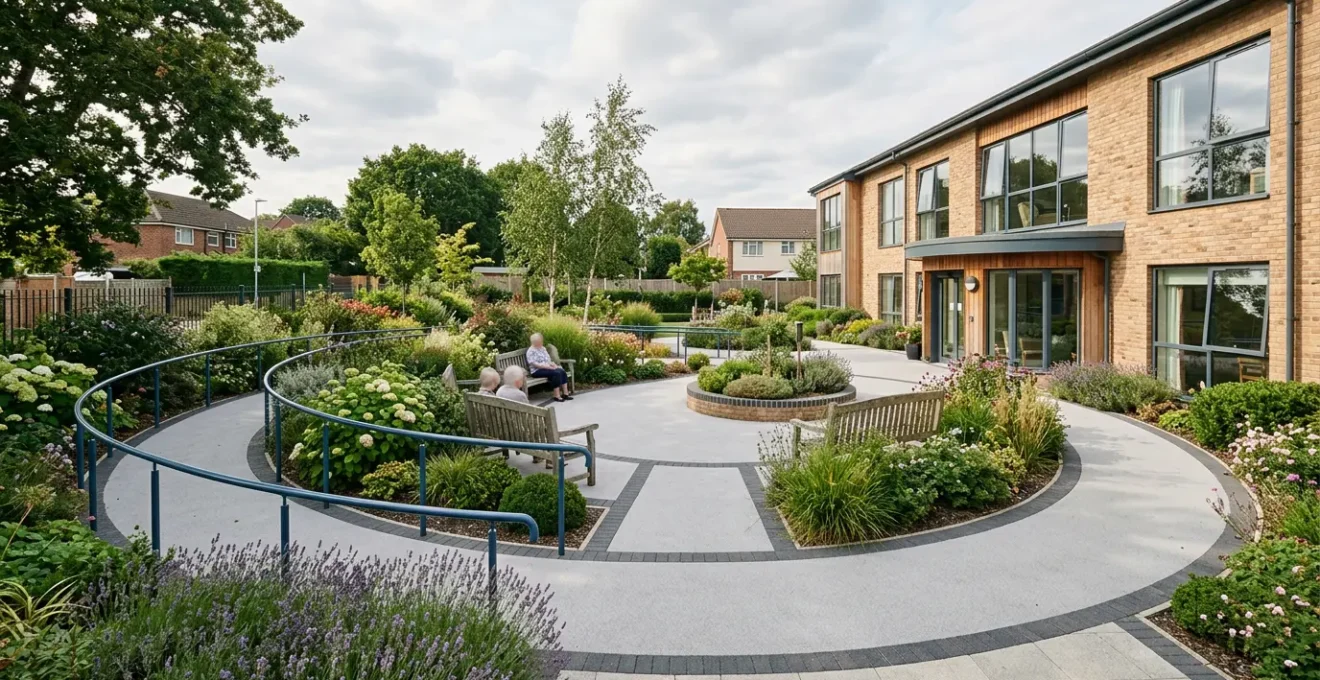
A ‘Dementia Gold Standard’ care home is defined not by basic safety compliance, but by its proactive culture of ‘enabling safety’ that prioritises dignity and independence.
- It requires families to move beyond CQC ratings and learn to assess a home’s specialist environmental design, staff expertise, and legal frameworks.
- Proactive planning—from getting a formal diagnosis to establishing Lasting Power of Attorney—is non-negotiable to avoid crisis-led decisions.
Recommendation: Use this guide’s checklists to systematically assess potential homes based on how well they support cognitive and sensory needs, not just physical ones.
The moment you realise a parent may need dementia care is profoundly difficult. The journey that follows—navigating a complex and emotional landscape of care homes, funding options, and legal decisions—can feel overwhelming. Standard advice often points you towards Care Quality Commission (CQC) ratings and encourages you to « get a feel » for a place during a visit. While essential, this is rarely enough. These metrics confirm compliance, but they don’t necessarily reveal a ‘gold standard’ of care.
The search for true excellence in dementia care goes deeper. It’s about understanding the difference between simple restriction and what specialists call enabling safety: creating an environment where a person with dementia can live with the greatest possible independence, dignity, and quality of life. This requires a shift in perspective, learning to see the world through the eyes of someone with cognitive challenges. It means looking for the subtle ‘cognitive ramps’ in a building’s design, understanding the nuances of communication when memory fades, and putting legal and financial protections in place long before a crisis hits.
But what if the key wasn’t just finding a safe building, but identifying a philosophy of care that actively supports the person’s remaining abilities? This guide is designed to equip you with that specialist lens. We will move beyond the basics to give you the practical tools and knowledge to assess the critical pillars of gold-standard dementia care in the UK.
This comprehensive article will walk you through the essential stages of this process, from initial concerns about memory to the specific details that define an outstanding care environment. The following sections provide a structured roadmap to help you make informed and confident decisions for your loved one.
Summary: Your Guide to Identifying True Dementia Care Excellence
- How to differentiate normal ‘senior moments’ from Mild Cognitive Impairment (MCI)?
- How to get a referral to a Memory Clinic through your GP?
- The error of delaying professional help until a crisis point is reached
- How to get a robust NHS Continuing Healthcare assessment for dementia funding?
- How to get legal consent to track a parent who lacks mental capacity?
- Dedicated dementia unit vs mixed care home: which is safer for wanderers?
- Why does contrasting color decor reduce falls and confusion for dementia patients?
- How to communicate effectively when your parent no longer recognizes you?
How to differentiate normal ‘senior moments’ from Mild Cognitive Impairment (MCI)?
One of the first and most challenging questions families face is distinguishing between normal, age-related forgetfulness and the early signs of a more significant cognitive issue. A ‘senior moment’—like misplacing keys or forgetting a name temporarily—is typically an occasional lapse that doesn’t disrupt daily life. Mild Cognitive Impairment (MCI), however, represents a more consistent and noticeable decline in cognitive ability that goes beyond the normal expectations of ageing. While it doesn’t prevent independent living, it makes complex tasks noticeably more difficult.

The key difference lies in the impact on daily function. A person with normal age-related changes might take longer to learn a new skill but will ultimately manage. Someone with MCI might struggle significantly with tasks that were previously routine, such as managing finances or following a recipe, even if they can still complete them. Family and friends, and often the person themselves, begin to notice this pattern and express concern. Understanding this distinction is the critical first step towards seeking a formal assessment.
This table, based on information from the NHS, outlines the key differences to help you identify the nature of the changes you’re observing. It provides a clearer framework for when to monitor and when to seek professional advice.
| Aspect | Normal ‘Senior Moments’ (Age-Related Cognitive Change) | Mild Cognitive Impairment (MCI) |
|---|---|---|
| Frequency & Pattern | Occasional forgetfulness (e.g., misplacing keys once a month) | Consistent pattern of cognitive decline noticeable to the person and/or close contacts |
| Memory Examples | Forgetting where you parked, but retracing steps to find it; forgetting a name but remembering later | Forgetting recent conversations entirely; repeatedly asking the same questions; struggling to recall recent events even with prompts |
| Impact on Daily Living | Does NOT interfere with independent daily activities – can manage bills, cooking, shopping without difficulty | Noticeable impact but does NOT yet prevent independence – e.g., managing bills takes much longer and more mistakes are made, but still achievable |
| Problem-Solving & Tasks | May take slightly longer to solve problems or learn new technology, but achieves tasks successfully | Significant difficulty with complex tasks, planning, or decision-making that was previously routine |
| Awareness | Person is aware of occasional lapses and may joke about them | Person may be aware and concerned; family/friends notice changes and express worry |
| Progression | Stable over time; does not worsen significantly year-to-year | Progressive decline measurable over months; may progress to dementia in some cases (but not all) |
| Next Steps | Monitor and maintain healthy lifestyle; no urgent medical assessment needed | Seek GP referral to Memory Clinic for formal assessment, diagnosis, and monitoring |
How to get a referral to a Memory Clinic through your GP?
If you suspect your parent’s memory issues are progressing beyond normal ageing, the next crucial step is to secure a referral to a specialist NHS Memory Clinic (or Memory Assessment Service) via their GP. This can sometimes feel like a hurdle, as GPs need clear evidence to make a referral. The key to a successful appointment is preparation. Vague descriptions like « Mum is more forgetful » are less effective than concrete, specific examples that demonstrate an impact on daily life and safety.
Before the appointment, create a log of specific incidents. Note down when your parent struggled with managing their medication, got lost on a familiar route, or repeatedly asked the same question within a short timeframe. When speaking to the GP, use a clear and direct phrase: « We believe this is more than normal ageing because it is affecting their ability to [manage finances/cook safely]. We would like a referral for a formal assessment to get a clear diagnosis. » Emphasise that an early diagnosis is not about finding a ‘cure’, but about unlocking access to vital support, future planning, and potential treatments. In England alone, recent data from Nuffield Trust shows that there will be nearly 500,000 people with a formal diagnosis by April 2025, highlighting the importance of the diagnostic pathway.
At the Memory Clinic, your parent will undergo a comprehensive assessment, which may include cognitive tests like the Addenbrooke’s Cognitive Examination (ACE-III), a physical check-up, and potentially a brain scan (CT or MRI). This is conducted by a specialist team, often including a geriatrician or a Community Psychiatric Nurse (CPN), who can provide a definitive diagnosis and a plan for moving forward. Being persistent and prepared is your best strategy for navigating this vital step.
Your Action Plan: Managing the GP Appointment for a Memory Clinic Referral
- Before the appointment, document specific examples of memory loss impacting daily life: struggling with managing finances, getting lost in familiar places, safety concerns like leaving the stove on, or difficulty with medication management.
- Avoid vague descriptions like ‘forgetful’ or ‘confused’ – instead use concrete examples: ‘Mum has asked me the same question five times in an hour’ or ‘Dad couldn’t find his way home from the local shop last week’.
- Use the key phrase: ‘We believe this is more than normal ageing because it’s affecting [specific daily task]. We would like a formal assessment to rule out or diagnose a progressive condition’.
- Request a referral to a Memory Clinic (also called Memory Assessment Service) for comprehensive assessment – explain you want specialist input, not just GP observation.
- Understand what to expect at the Memory Clinic: you’ll meet a geriatrician or Community Psychiatric Nurse (CPN), complete cognitive tests like the Addenbrooke’s Cognitive Examination (ACE-III), and possibly have brain scans (CT/MRI).
- If the GP is hesitant, explain how early diagnosis enables access to support services, medication options, legal planning (LPA), and NHS Continuing Healthcare eligibility – emphasize the benefits of proactive assessment.
The error of delaying professional help until a crisis point is reached
One of the most common and damaging mistakes families make is waiting for a crisis—a fall, a hospital admission, or a significant safety incident—before seeking professional help or planning for long-term care. This reactive approach, born from hope or denial, often leads to rushed, stressful decisions made under immense pressure. Proactive planning, while emotionally difficult, is the cornerstone of ensuring your parent receives the best possible care and that their wishes are respected.
The statistics paint a stark picture of this reality. For people with dementia in England, data from Alzheimer’s Research UK reveals that an astonishing 77% of their hospital stays are emergency admissions, many of which could be avoided with better community support and forward planning. Acting early means putting critical legal and healthcare structures in place while your parent still has the mental capacity to participate in decisions about their future. This is not about giving up; it is about taking control.
Key proactive steps include setting up a Lasting Power of Attorney (LPA) for both Health and Welfare and Property and Financial Affairs. An LPA is a legal document that allows your parent to appoint a trusted person (the ‘attorney’) to make decisions on their behalf if they lose capacity in the future. Without it, you may have to apply to the Court of Protection, a far more costly and lengthy process. Similarly, requesting a Carer’s Assessment from your local council and initiating an Advance Care Plan (ACP) discussion with the GP are vital pre-crisis actions that open doors to support and ensure your parent’s preferences are documented.
How to get a robust NHS Continuing Healthcare (CHC) assessment for dementia funding?
The cost of full-time dementia care is a significant concern for most families. With the Alzheimer’s Society stating the average annual cost can be around £32,250 per person in the UK, understanding funding options is critical. NHS Continuing Healthcare (CHC) is a package of care arranged and funded solely by the NHS for individuals who are assessed as having a ‘primary health need’. Many people with advanced dementia should qualify, yet the assessment process is notoriously complex and often misunderstood.
To be eligible for CHC, the assessment must show that your parent’s need for care is primarily health-related, not a ‘social need’. This is determined by a Multi-Disciplinary Team (MDT) using a Decision Support Tool (DST) which evaluates the nature, intensity, complexity, and unpredictability of their needs across 12 care domains. For dementia, the most relevant domains are often ‘Behaviour’, ‘Cognition’, and ‘Psychological/Emotional Needs’. The biggest mistake families make is under-representing the severity and consistency of these needs.
The key to a robust assessment is building a detailed evidence file. For at least two to four weeks leading up to the assessment, keep a meticulous daily diary. Document every incident of agitation, confusion, wandering, or distress, explicitly linking it to the language of the DST. Record evidence of needs on ‘bad days’, not just average ones. Crucially, you have the right to request that a dementia specialist, such as an Admiral Nurse, be part of the MDT. Their expertise can be invaluable in ensuring the panel fully understands the complexity of the condition. If funding is denied, do not give up; you have the right to appeal the decision via your local Integrated Care Board (ICB) and then to NHS England.
How to get legal consent to track a parent who lacks mental capacity?
Wandering is a common and dangerous behaviour associated with dementia, causing immense stress for families. GPS tracking technology offers a powerful tool to enhance safety and provide peace of mind, but its use raises important legal and ethical questions, especially when a person can no longer consent. In the UK, the legal framework for this decision rests on the Mental Capacity Act 2005. You cannot simply decide to track your parent; you must follow a formal process to ensure the decision is lawful and in their ‘best interest’.
First, the two-stage capacity test must be applied: Does the person have an impairment of the mind or brain? And does that impairment mean they are unable to make this specific decision about being tracked at this time? If the answer to both is yes, the decision falls to the person legally authorised to make it. If your parent has appointed you as their attorney under a Health and Welfare Lasting Power of Attorney (LPA), that authority rests with you. If no LPA exists, the decision must be made by consulting with family and relevant healthcare professionals, always adhering to the ‘best interest’ principle.
The ‘best interest’ test is not just about safety; it requires you to consider whether tracking is the least restrictive option. Have you considered alternatives like creating a more secure home environment or using an identification bracelet? You must also weigh the benefit of safety against the impact on your parent’s dignity and privacy. Despite its potential, a UK survey of 99 caregivers found that only 7% currently benefit from tracking technology, with a further 11% who could have benefited from it, suggesting a gap in awareness and implementation. Crucially, document every step of your decision-making process: who you consulted, what alternatives were considered, and why you believe this is the best course of action.
Dedicated dementia unit vs mixed care home: which is safer for wanderers?
When a person with dementia has a tendency to wander, choosing the right type of care home becomes a critical safety decision. The choice often comes down to a specialist, dedicated dementia unit versus a general ‘mixed’ care home that cares for residents with a variety of needs. While a mixed home might seem socially diverse, for a person prone to wandering, a dedicated unit is almost always the safer and more appropriate environment.
The fundamental difference lies in their approach. A dedicated unit is purpose-built to enable safe wandering. It incorporates design features like secure circular gardens, sensory corridors, and ‘rummage stations’ that allow residents to move freely and purposefully without risk. The entire philosophy is geared towards understanding wandering not as a ‘problem behaviour’ to be stopped, but as a form of communication or a response to an unmet need. In contrast, a general care home may rely on more restrictive measures like locked doors, which can increase a resident’s agitation and lead to a formal ‘Deprivation of Liberty’ without the specialist understanding to manage it appropriately.
Staff expertise and environmental design are also vastly different. In a dedicated unit, all staff are trained in dementia-specific communication and de-escalation techniques. The physical environment is a therapeutic tool, using principles we’ll discuss next, such as colour contrast and non-reflective flooring, to reduce confusion. As the table below highlights, these differences have a profound impact on a resident’s safety, dignity, and overall quality of life. The legal framework of Deprivation of Liberty Safeguards (DoLS) is also more robustly and expertly applied in specialist settings.
This comparative analysis, drawn from guidance by organisations like the Alzheimer’s Society, clarifies the distinct advantages of a specialist unit for managing wandering safely.
| Feature | Dedicated Dementia Unit (Specialist) | Mixed Care Home (General) |
|---|---|---|
| Wandering Management Approach | Enables safe wandering with secure circular gardens, sensory corridors, and ‘rummage stations’ for stimulation | Often relies on locked doors or restrictive measures to prevent wandering |
| Legal Framework (DoLS) | Deprivation of Liberty Safeguards applied robustly with documented ‘best interest’ decisions by trained staff | DoLS may be inconsistently applied; staff may lack training in legal requirements for managing wandering |
| Staff Expertise | All staff trained in de-escalation, understanding wandering as communication, and person-centered dementia care | General care training; staff may lack specialist dementia knowledge, potentially causing resident frustration |
| Environmental Design | Purpose-built with contrasting colors, clear wayfinding cues, non-reflective flooring, and minimal environmental triggers | Standard care home design; may lack dementia-specific adaptations like color contrast or acoustic management |
| Activity & Stimulation | Structured dementia-specific activities, memory therapy, and safe spaces for purposeful movement throughout the day | General activities; may not address the specific cognitive and sensory needs of people with advanced dementia |
| Safety Monitoring | Discreet technology (e.g., geo-fencing, movement sensors) integrated with person-centered care plans | May use basic monitoring; technology integration and specialist care planning often limited |
Why does contrasting color decor reduce falls and confusion for dementia patients?
When you visit a potential care home, the decor might seem like a purely aesthetic choice. But in a gold-standard dementia unit, it is a critical safety feature. People with dementia often experience changes in visual and spatial perception, making it difficult to interpret their surroundings. A lack of contrast can cause objects to blend into the background, increasing the risk of falls, confusion, and anxiety. Using strong, contrasting colours is one of the most effective ways to create ‘cognitive ramps’ that help residents navigate their environment more safely and independently.

A simple but powerful example is the toilet. A white toilet seat against a white wall and on a white floor can become effectively invisible to someone with perceptual difficulties, leading to accidents and a loss of dignity. A brightly coloured toilet seat (e.g., red or blue) provides a clear visual cue that helps the resident locate and use the facility. The same principle applies to handrails, doorframes, and even tableware. A brightly coloured handrail against a neutral wall stands out, offering support when needed. A plate that contrasts with the colour of the food on it can help stimulate appetite and enable a person to eat more independently.
Furthermore, reflective or patterned flooring can be terrifying, as it can be perceived as water, a hole, or an obstacle, causing a person to freeze or try to step over it. Gold-standard homes use non-reflective, matte-finish flooring in consistent tones to create a sense of stability. When assessing a home, look for these details. They are not just ‘dementia-friendly’; they are evidence of a deep, specialist understanding of how to create a truly enabling and safe environment, which is vital when considering that wandering is a significant concern for many families.
Key Takeaways
- A ‘Dementia Gold Standard’ is about enabling independence and dignity, not just ensuring basic safety.
- Proactive legal and financial planning (LPA, CHC assessment) before a crisis is the most critical action a family can take.
- The physical environment, especially the use of colour contrast and non-reflective surfaces, is a direct measure of a care home’s specialist expertise.
How to communicate effectively when your parent no longer recognizes you?
Perhaps the most painful moment in the dementia journey is when a parent no longer verbally recognizes you. It can feel like the connection is lost forever. However, gold-standard care teaches us that when cognitive recognition and verbal communication fade, a deeper, more profound form of sensory communication can take its place. It requires shifting from trying to ‘make them remember’ to simply ‘being with them’ in the present moment, connecting through touch, sound, and familiar sensations.

Arguing or repeatedly stating your name (« But Mum, it’s me, your son! ») often increases distress and confusion. Instead, accept their reality in that moment and focus on non-verbal cues. A gentle touch on the hand, a warm and reassuring tone of voice, or simply sitting with them in comfortable silence can communicate love and safety far more effectively than words. Music is an incredibly powerful tool for this. A song from their youth can unlock emotions and memories that are inaccessible through conversation, providing a shared experience of joy and connection.
This approach moves beyond the frustration of failed conversations and builds a new kind of relationship based on emotional and sensory presence. It’s about maintaining dignity and reassuring the person that they are safe and loved, regardless of what or who they remember.
Case Study: The Impact of Sensory Communication
The NHS RightCare dementia scenario documents how personalized music therapy and non-verbal communication strategies transformed care for Tom, a patient with advancing dementia. When Tom no longer recognized family members and became distressed during hospital admission, the introduction of music from his youth (1960s recordings he enjoyed) alongside therapeutic touch and memory boxes with tactile objects (his gardening tools, photographs) enabled emotional connection. The Transfer of Care Admiral Nurse, James, worked with the family to implement these communication approaches, resulting in reduced anxiety, fewer behavioral incidents, and Tom feeling ‘much more relaxed’ even when verbal recognition was absent. The case demonstrates how shifting from verbal to sensory communication channels – music, touch, familiar objects – maintains human connection and dignity when cognitive recognition fails.
Now that you are equipped with this specialist knowledge, you can begin to assess potential care homes not as a worried family member, but as an informed advocate for your parent. Use these insights to ask deeper questions, observe the environment with a critical eye, and champion a standard of care that truly honours their dignity and humanity.