
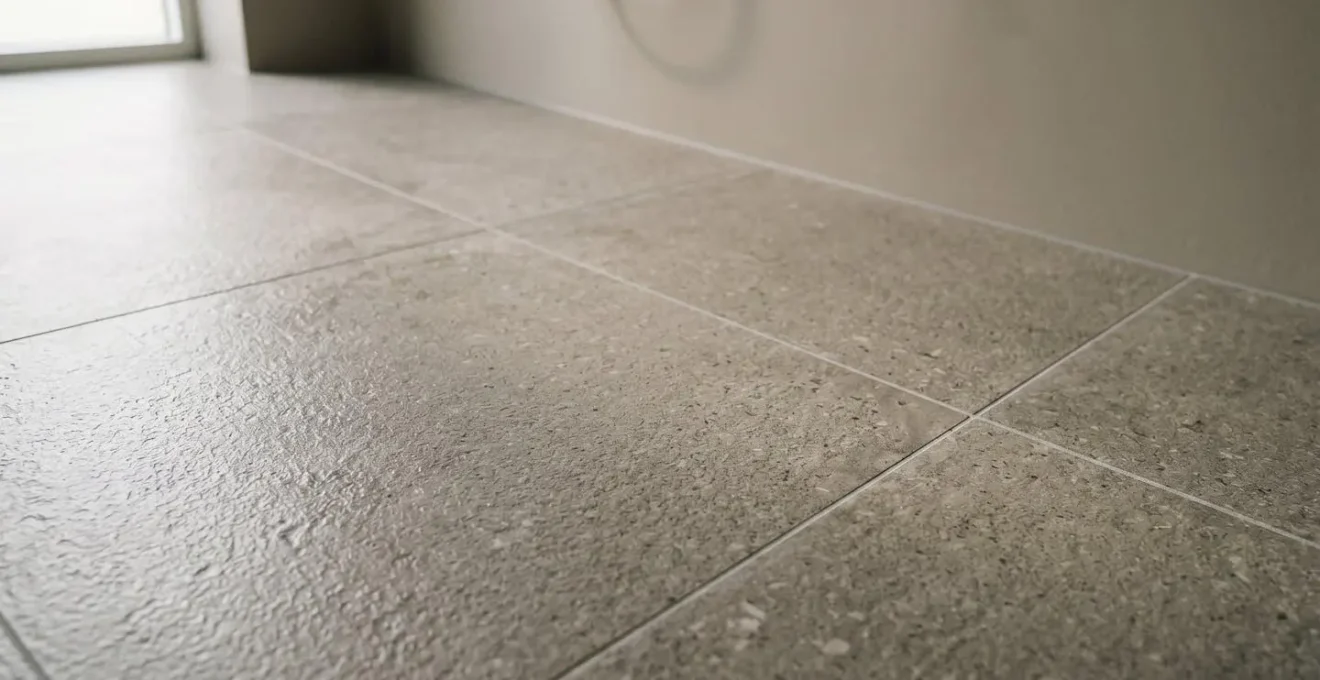
The secret to a safe, elegant floor isn’t just picking an ‘R11’ rating; it’s understanding the science of surfaces to integrate safety seamlessly into your home’s design.
- An R10 rating is insufficient for wet areas because it fails to manage water effectively underfoot, drastically reducing the real-world coefficient of friction.
- Modern safety flooring, from micro-etched tiles to advanced vinyl, now offers sophisticated aesthetics that move far beyond the outdated institutional look.
Recommendation: Prioritise flooring choices based on their proven slip-resistance in wet conditions and their ability to create seamless, zero-height transitions between rooms.
The desire for a home that is both beautiful and safe is universal, yet it often feels like a compromise, especially when considering flooring for areas prone to slips. For years, the prevailing advice has been to install clinical-looking, high-grip floors, sacrificing personal style for peace of mind. Many homeowners believe the choice is binary: a chic, potentially hazardous surface or a utilitarian, « hospital-grade » floor. This often leads to stop-gap measures like bath mats and temporary coatings, which can paradoxically introduce new risks.
But what if this premise is flawed? The key to achieving a truly safe and stylish home environment doesn’t lie in reluctantly accepting an industrial aesthetic. It lies in a deeper understanding of the science of surfaces, the ergonomics of movement, and the technology of modern materials. As the wis.it.com research team highlights, « While overall fall risk increases with age, the concentrated dangers within the bathroom make it a hotbed for accidents, » underscoring the need for a more intelligent approach. Indeed, research confirms that for older adults, 80% of falls in the home occur in the bathroom, making this room a critical focus.
This article will deconstruct the myths surrounding safety flooring. We will move beyond simply stating ratings and instead explore the principles of slip resistance, the realities of maintenance, and the elegant solutions now available. By focusing on the ‘why’ behind the ‘what’, you can make informed design decisions that integrate safety so seamlessly, it becomes an invisible part of your home’s beauty.
To guide you through this process, this article breaks down the essential considerations, from understanding technical ratings to achieving a flawless aesthetic flow throughout your home.
Summary: A Guide to Stylish and Safe R11 Flooring
- Why is an ‘R10’ rating insufficient for a wet room used by a senior?
- How to treat existing ceramic tiles to make them non-slip without replacing them?
- Safety vinyl (Altro) vs textured tiles: which is easier to keep clean?
- The mistake of using thick bath mats on top of non-slip flooring
- How to clean safety flooring without destroying the aggregate grip?
- Double-sided tape vs removing rugs entirely: which is safer for shuffling gaits?
- Flush thresholds vs ramped strips: achieving a seamless flow between rooms
- How to create a truly open-plan ground floor in a UK semi-detached house?
Why is an ‘R10’ rating insufficient for a wet room used by a senior?
To the untrained eye, the difference between an R10 and an R11 slip-resistance rating seems minor. However, in the context of a wet room, shower, or bathroom used by a senior, that single-digit difference represents a critical safety threshold. The ‘R’ rating, a German standard, measures slip resistance on a ramp inclined at varying angles. A film of oil is used in the test to simulate a slippery substance, but the key is understanding what these angles mean in a real-world, water-covered environment.
The fundamental issue is how the floor’s surface, or its micro-topography, interacts with water. An R10 floor has a surface texture sufficient to provide grip in dry conditions or with minimal water. But when standing water is present, as it always is in a shower, this lesser texture is not enough to displace the water from under the sole of the foot. A thin film of water remains, creating an aquaplaning effect that dramatically lowers the real-world coefficient of friction—the technical measure of grip.
An R11-rated floor, by contrast, is engineered with a more pronounced surface profile. It has the necessary peaks and valleys to channel water away from the point of contact, ensuring the foot (or shoe) makes direct contact with the flooring material itself. This is the crucial difference, as defined by the classification system:
- R9: Slip-resistant up to 3° to 10°. Suitable only for dry, private areas.
- R10: Slip-resistant up to 10° to 19°. Recommended for « barrier-free » spaces but not those with constant water presence.
- R11: Slip-resistant up to 19° to 27°. Specifically provides the increased static friction needed for wet, barefoot areas.
- R12-R13: Designed for extreme industrial or commercial conditions with high levels of grease or contaminants.
For a senior, whose balance and reaction time may be reduced, relying on an R10-rated floor in a wet room is a gamble. It provides a false sense of security that vanishes the moment enough water is present. Opting for R11 isn’t a matter of over-engineering; it’s the scientifically validated minimum for ensuring reliable grip where it matters most.
How to treat existing ceramic tiles to make them non-slip without replacing them?
Replacing an entire tiled floor is a disruptive and costly project. Fortunately, if your existing ceramic or porcelain tiles are in good condition but lack the necessary grip, there are effective treatments that can significantly improve safety without a full renovation. The two primary methods are applying topical coatings and using a chemical etching process, each with distinct advantages and aesthetic impacts.
Topical coatings involve applying a clear, often textured, sealer to the tile surface. These products add a physical layer of grip. Their main advantage is that they are non-permanent and can be a good solution for renters or for testing a surface’s feel before committing to a permanent change. However, their durability is limited and they require re-application every few years.
Chemical etching, on the other hand, is a permanent solution. This process uses a mild acid-based solution that reacts with the silica in the tile’s glaze, creating microscopic pores on the surface. These pores are invisible to the naked eye but act like tiny suction cups when wet, dramatically increasing the coefficient of friction. The treatment doesn’t add a layer; it permanently alters the tile’s own surface. The main aesthetic consideration is that it can reduce the gloss on very shiny tiles, resulting in a more matte or satin finish, which many people find preferable anyway.
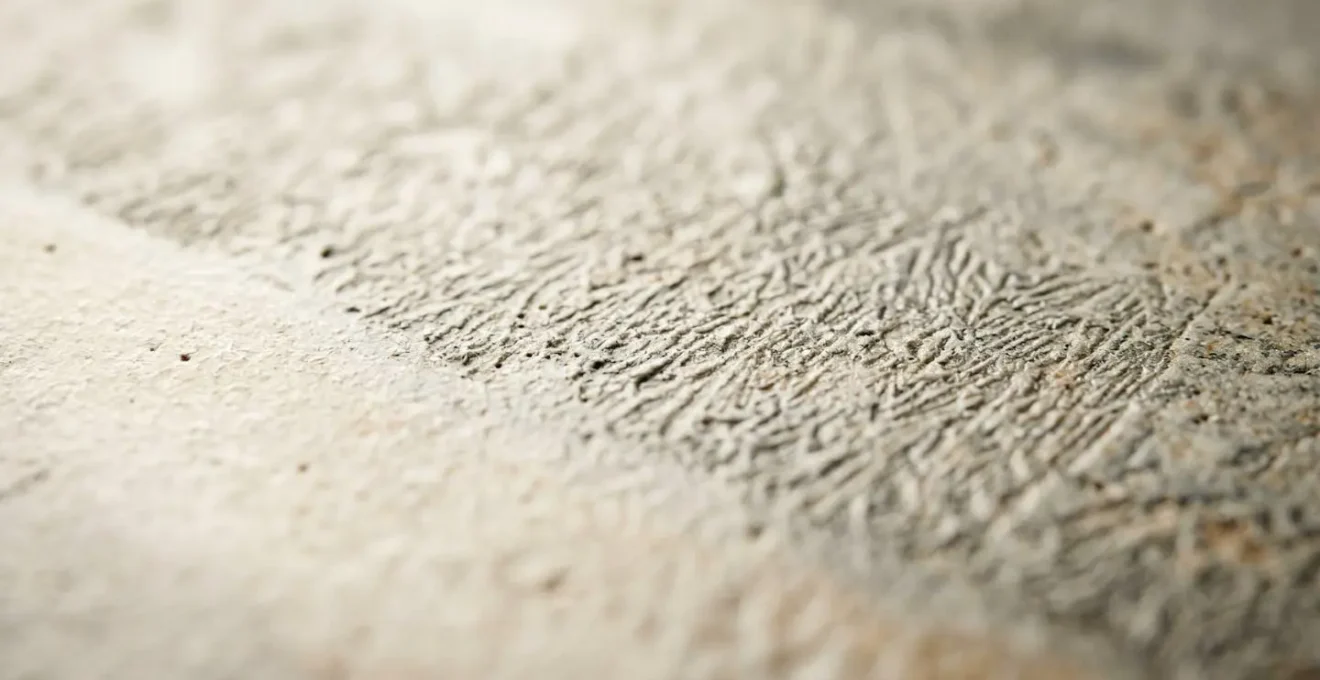
As the image above illustrates, the process creates an intricate micro-texture that is the key to its effectiveness. For a long-term, low-maintenance solution, chemical etching is often the superior professional choice. The following comparison, based on a recent analysis of treatment methods, outlines the key differences:
| Treatment Method | How It Works | Durability | Aesthetic Impact | Best For |
|---|---|---|---|---|
| Topical Coatings | Clear nanocoating or textured sealer applied to surface | 1-3 years, requires re-application | May add slight sheen or texture; mostly transparent | Temporary solution, renters, testing before permanent change |
| Adhesive Treads | High-quality transparent strips applied to specific zones | Variable, requires monitoring and replacement | Visible strips; targeted application | High-risk zones like shower exits; supplement to other methods |
| Chemical Etching | Acid-based treatment creates microscopic pores in tile surface | Permanent (4+ years guarantee) | Reduces gloss on glossy tiles; may slightly dull finish | Long-term solution for porcelain and ceramic; one-time treatment |
Safety vinyl (Altro) vs textured tiles: which is easier to keep clean?
When selecting new flooring, the debate often comes down to two excellent choices for wet areas: high-quality safety vinyl and modern textured porcelain tiles. Both can achieve an R11 rating and offer sophisticated aesthetics. However, a crucial long-term consideration is the ease of cleaning, as the very features that provide grip can also trap dirt.
Textured porcelain tiles are incredibly durable and non-porous. Their pattern is part of the tile body, so it won’t wear off. Cleaning is generally straightforward with standard methods, but the grout lines can be a weak point. Grout is porous and can stain or harbour mould if not sealed and maintained properly. The texture of the tile itself can also hold onto soap scum and require a stiff brush to clean effectively.
Specialist safety vinyl, on the other hand, is a seamless surface, completely eliminating the issue of grout maintenance. Top-tier manufacturers have invested heavily in solving the cleanability puzzle inherent in aggregate-based flooring. The aggregate (hard particles like quartz and aluminium oxide) that gives the vinyl its exceptional grip can make it challenging to clean with a standard mop, which may snag or leave behind residue. This challenge led to significant innovation in the field.
Case Study: Altro’s Easyclean Technology Development
Altro, a pioneer in safety flooring since 1947, developed their proprietary Easyclean Technology specifically to address the cleaning challenge inherent in aggregate-based slip-resistant vinyl. The technology was engineered to maintain sustained slip resistance while simplifying maintenance. Their flagship product, Altro Aquarius, which is designed for wet, barefoot areas, underwent seven years of laboratory and field testing before launch. This extensive R&D demonstrates the complexity of balancing world-class safety performance with the practical need for easy, effective cleaning in modern vinyl flooring systems.
Ultimately, the choice depends on priorities. Textured tiles offer timeless durability but require diligent grout care. Modern safety vinyl provides a seamless, hygienic surface, but demands a specific cleaning technique (which we’ll cover next) to maintain both its appearance and its grip. For ultimate low-maintenance and hygiene, a high-quality safety vinyl with proven easy-clean technology often has the edge.
The mistake of using thick bath mats on top of non-slip flooring
It seems like a common-sense solution: place a soft, absorbent bath mat on the floor for comfort and to soak up water. However, this introduces what can be called the « Hazard Paradox »: a well-intentioned safety measure that creates a new, often greater, risk. According to the Centers for Disease Control and Prevention (CDC), falls are a serious public health problem, with over 235,000 people aged 15 and older being treated in emergency rooms for bathroom fall injuries each year in the US alone. Many of these incidents are related to tripping, not just slipping.
A thick bath mat placed on top of a perfectly good non-slip floor creates several problems. First, it introduces an uneven surface and a raised edge, a primary trip initiator for anyone, but especially for those with a shuffling gait. Second, if the mat doesn’t have a fully non-slip backing, it can slide on the floor, negating the benefit of the safe flooring underneath. Third, mats can become saturated with water, taking a long time to dry and potentially creating a breeding ground for mould and mildew.
The solution is not to add layers, but to integrate comfort into the primary surface itself. Instead of a cold tile floor that necessitates a mat, a more elegant and safer solution is to choose a flooring material that feels warmer underfoot, such as high-quality safety vinyl, or to install underfloor heating. This technology provides a consistent, gentle warmth that eliminates the cold shock of a tile floor, removing the perceived need for a bath mat entirely. It creates a single, seamless, and safe surface.
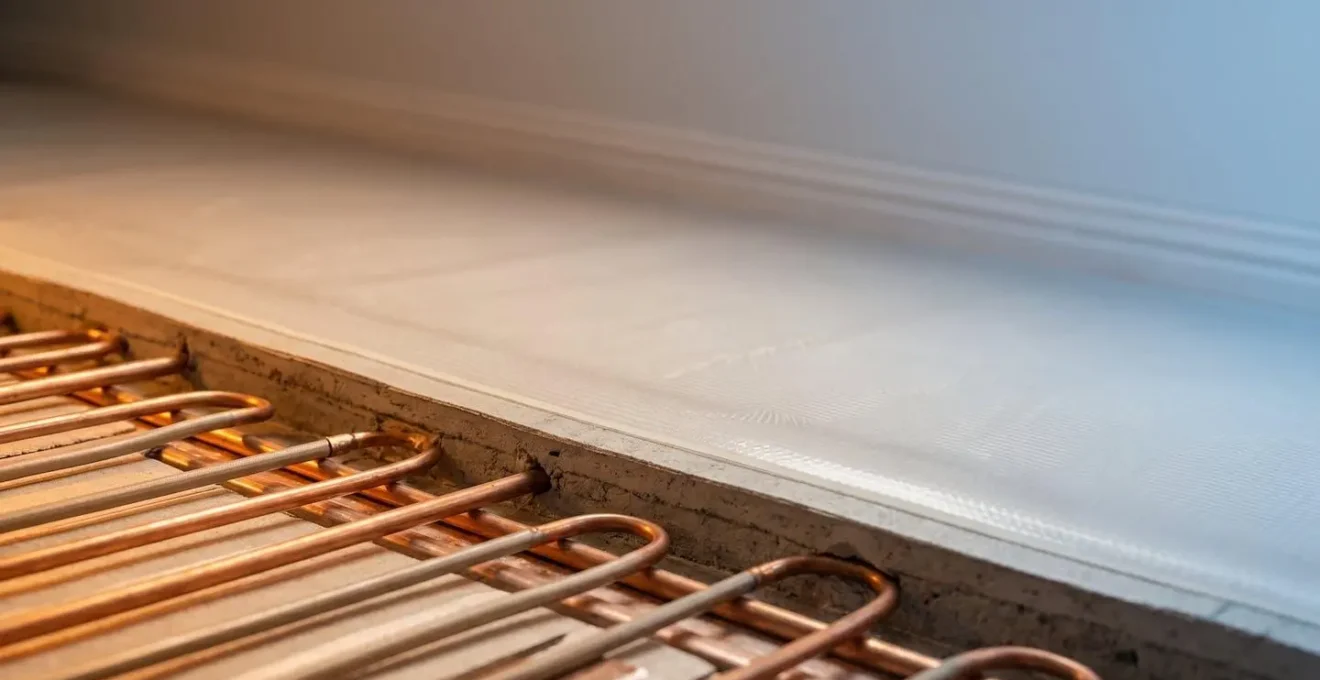
By integrating warmth directly into the floor, you remove trip hazards, improve hygiene, and create a more luxurious and comfortable experience. This is a prime example of aesthetic integration, where a design choice enhances both safety and style simultaneously, rather than pitting them against each other.
How to clean safety flooring without destroying the aggregate grip?
You’ve invested in a high-performance R11 safety floor. The key to ensuring it provides sustained slip resistance for its entire lifespan is correct maintenance. Using the wrong cleaning methods or products is the fastest way to diminish its effectiveness. Harsh chemicals can damage the surface, while waxy « mop and shine » products can fill in the microscopic texture, effectively turning your safety floor into a slippery hazard.
The goal of cleaning safety flooring is twofold: remove dirt and grease, and keep the aggregate-based texture free of residue. A standard string mop is ineffective as it glides over the top of the texture, leaving dirt in the valleys, and its fibres can get snagged. The correct approach requires a bit more mechanical action but is simple once you have the right tools and technique.
A pH-neutral cleaner is essential, as highly alkaline or acidic products can degrade the vinyl or its surface treatment over time. The most effective method involves using a medium-stiff deck brush to gently scrub the surface, lifting dirt out of the texture without being abrasive enough to damage the aggregate peaks. This ensures the floor’s micro-topography remains intact and fully functional. Following a professional protocol is the best way to protect your investment.
Your action plan: The correct cleaning protocol for aggregate safety flooring
- Daily Dry Removal: Start with a daily dry sweep or vacuum to remove loose debris that can abrade the surface over time.
- Two-Bucket Method: Prepare one bucket with a recommended pH-neutral cleaner solution and a second bucket with clean rinse water to prevent re-applying dirty water.
- Apply and Agitate: Apply the cleaning solution using a medium-stiff polypropylene deck brush. A standard mop is not suitable for this task.
- Scrub Correctly: Work the brush in gentle circular motions. This action is crucial for lifting dirt from the valleys between the aggregate particles without wearing down the peaks.
- Rinse Thoroughly: Use the clean water from your second bucket to rinse the floor completely, ensuring all cleaning residue is removed. A wet-vac can make this step easier.
Finally, never use bleach, wax, or polish on safety flooring. These products are the enemy of slip resistance. A quarterly deep clean with a specialized safety floor degreaser can also help remove any buildup of body oils or soap scum that regular cleaning might miss.
Double-sided tape vs removing rugs entirely: which is safer for shuffling gaits?
The debate over rugs in a senior’s home is a persistent one. They add warmth, style, and acoustic dampening, but they are also a notorious trip hazard. The common compromise is to secure them with double-sided tape, but is this truly a safe solution, especially for individuals with a shuffling or unsteady gait? The reality is that any raised surface, however small, can pose a significant risk, and falls are a serious concern, with around 30% of falls resulting in injuries like fractures for seniors.
Double-sided tape is a temporary and unreliable fix. Its adhesive degrades over time due to dust, foot traffic, cleaning, and changes in humidity. A corner or edge can easily lift, creating the perfect catch-point for a foot. For someone with a shuffling gait, who may not lift their feet completely, even a slightly loose edge becomes a major hazard. The false sense of security a taped-down rug provides can be more dangerous than having no rug at all.
From a pure safety perspective, there is a clear hierarchy of risk when it comes to floor coverings. The safest option is always a continuous, single-surface floor. Any compromise from this ideal introduces a degree of risk.
- Level 1 (Safest): No rugs. A continuous non-slip flooring surface throughout the home with zero height transitions is the gold standard for fall prevention.
- Level 2 (Acceptable Compromise): Low-profile, fully-backed non-slip mats. If a mat is necessary (e.g., at an entrance), it must be very thin (under 5mm), have a high-grip rubber backing that will not slide, and be placed in a strategic, non-transitional location.
- Level 3 (High Risk): Taped-down rugs. The adhesive is an unpredictable point of failure.
- Level 4 (Unacceptable): Loose rugs of any kind. These are the primary initiators of trips and falls for those with unsteady gaits.
The unequivocal answer is that removing rugs entirely is vastly safer than attempting to secure them with tape. The modern solution is to choose a primary flooring material that provides the desired warmth and aesthetic, such as a high-quality LVT or safety vinyl with a comfortable feel, rendering the need for area rugs obsolete.
Flush thresholds vs ramped strips: achieving a seamless flow between rooms
A truly safe and accessible home is defined by its seamlessness. Even a small change in floor height between rooms—a standard door threshold, a transition strip—can disrupt the flow and become a significant trip hazard. The goal of modern, accessible design is to achieve completely flush thresholds, creating an uninterrupted plane from one space to the next. This is not only crucial for wheelchair users but also for anyone with a shuffling gait.
Traditionally, transition strips were necessary to hide the gap between two different flooring materials or to accommodate slight differences in subfloor height. Ramped strips offer a slight improvement over abrupt thresholds, but they still introduce an incline and a change in surface that can be problematic. The ideal is to eliminate the need for them altogether. This is where the choice of flooring material and installation method becomes critical.
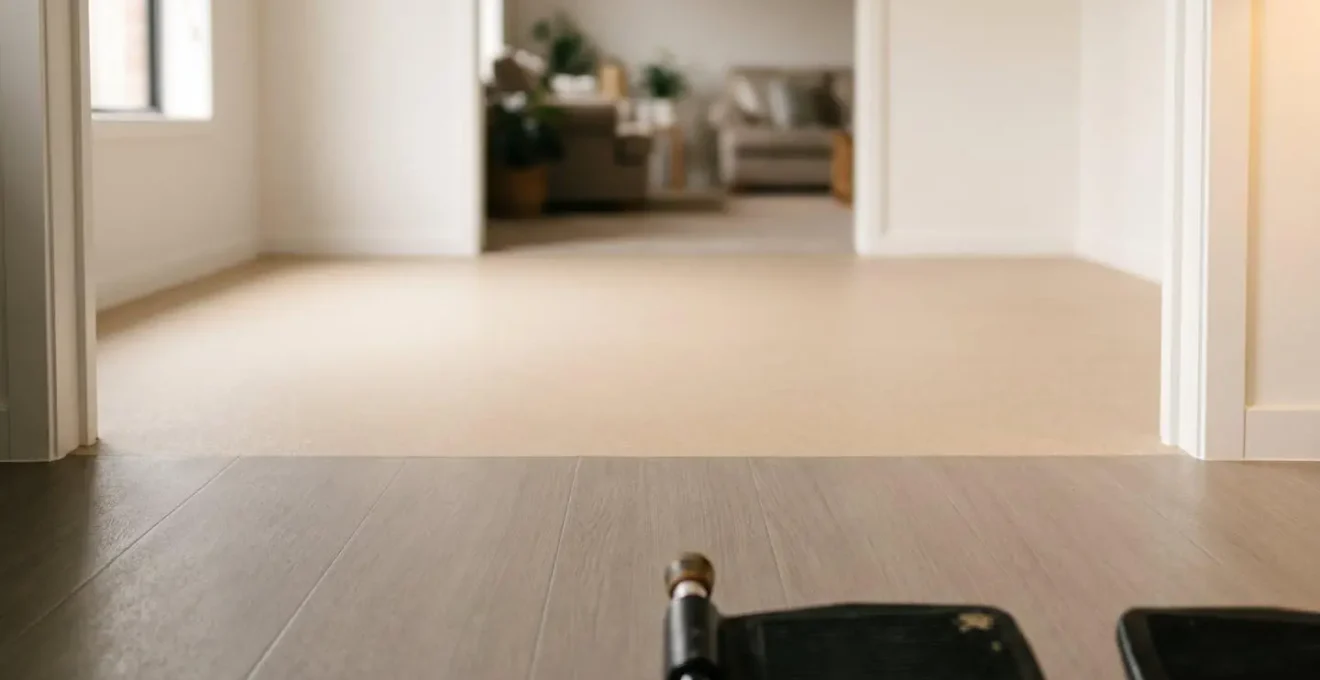
Achieving a flush transition, as shown in the image above, depends on two factors: careful subfloor preparation and the use of modern flooring systems. The subfloor must be perfectly level across the entire area. When this isn’t possible, modern flooring technologies can provide a solution.
Case Study: Altro’s Adhesive-Free Installation
Altro’s adhesive-free flooring technology demonstrates how modern installation methods can achieve near-flush transitions while accommodating subfloor irregularities. The system’s studded underside allows installation directly over existing floors, including slightly uneven ones, at up to 97% relative humidity, halving installation time compared to traditional methods. Critically for renovations, the technology eliminates the 3-week wait required when installing ceramic tiles over new underfloor heating systems, allowing the heating to remain active throughout installation. This case illustrates how material choice impacts not just the final threshold profile but the entire construction timeline and its associated disruption.
By selecting a flooring system that can be installed continuously between rooms, you create a single, unified surface. This approach to seamless transition ergonomics is the pinnacle of combining high-end aesthetics with uncompromising safety. It transforms a collection of separate rooms into a single, accessible, and gracefully flowing living space.
Key Takeaways
- An R11 rating is the non-negotiable minimum for wet areas; R10 provides a false sense of security.
- Integrated solutions like underfloor heating are safer and more elegant than adding high-risk accessories like bath mats.
- True safety comes from seamless design, eliminating all height transitions between rooms with flush thresholds.
How to create a truly open-plan ground floor in a UK semi-detached house?
The principles of safe and stylish flooring culminate in the challenge of creating a modern, open-plan living space, a popular renovation goal in typical UK semi-detached houses. Here, the flooring is not just a collection of surfaces in different rooms; it becomes the single unifying element that defines the entire ground floor. A successful open-plan design depends on the floor to provide visual continuity, unwavering safety, and even acoustic comfort.
Choosing a single flooring material to run throughout the space—from the living area, through the dining space, and into the kitchen—is key to achieving a cohesive, expansive feel. This is where high-quality safety vinyl or textured LVT (Luxury Vinyl Tile) excels. They can provide the necessary R11 slip resistance for the kitchen area while offering a sophisticated aesthetic (such as wood or stone effects) that feels perfectly at home in the living room. This avoids awkward transitions and creates a seamless visual flow.
In an open-plan environment, acoustics also become a major consideration. Sound travels easily, and the noise of footsteps, dropped items, or chairs being moved can become disruptive. Advanced flooring solutions address this directly. For instance, certain advanced safety flooring products now offer an integrated acoustic backing, providing an impact sound reduction of up to 14dB. This small detail can make a huge difference to the comfort and tranquillity of the space, transforming it from an echo chamber into a peaceful environment.
Ultimately, creating a truly successful open-plan ground floor is a holistic design exercise. It requires moving beyond thinking about flooring on a room-by-room basis and instead considering it as the foundational canvas for the entire space. The right choice will provide a continuous, beautiful surface that is safe underfoot in all zones, easy to maintain, and acoustically comfortable—proving that safety and high-end design are not mutually exclusive, but are in fact essential partners.
To ensure your project successfully integrates these critical aspects of safety and design, the next logical step is to consult a specialist who understands the science of surfaces and can help you select the perfect solution for your home.