
The secret to successfully future-proofing a Victorian home is not about adding intrusive gadgets, but about making subtle, strategic architectural interventions that enhance both safety and the building’s inherent elegance.
- Prioritise ‘architectural integration’, where safety features like support rails and sensors are concealed within the period details.
- Favour ‘broken-plan’ layouts over fully open-plan designs to maintain structure, support, and a sense of security.
Recommendation: Develop a long-term masterplan with a specialist architect, focusing on phased adaptations that address immediate needs while anticipating future mobility changes.
The love for a Victorian terrace house is often a love for its imperfections: the charmingly uneven floors, the intricate ceiling cornices, and the way light falls through a tall sash window. For many owners, the thought of adapting this character-filled space for the practicalities of later life feels like a compromise at best, and a desecration at worst. The common advice often involves bulky, clinical-looking additions—stairlifts that dominate narrow staircases and stark white plastic grab rails that clash with period tiling.
This approach forces a false choice between safety and style, between independence and the home you cherish. But what if the true art of adaptation wasn’t about bolting on solutions, but about thoughtful, almost invisible, integration? What if the key to ageing gracefully in place lies not in surrendering to clinical aids, but in leveraging smart design to make the home’s original character part of the solution? This is the philosophy of aesthetic accessibility: enhancing safety through interventions that are so well-designed they feel like they were always meant to be there.
This guide moves beyond the obvious to explore the architectural strategies that preserve the soul of your period property. We will analyse the hidden dangers in traditional layouts, compare the real financial and emotional costs of major decisions, and uncover sophisticated design principles that deliver safety without sacrificing the beauty and integrity of your home. It’s about creating a space that supports you discreetly, allowing you to continue enjoying the home you love, safely and with dignity, for many years to come.
To navigate this complex topic, this article is structured to address the most pressing questions homeowners face, from specific problem areas to the intricacies of planning and regulations. The following summary provides a roadmap to creating a safe, stylish, and sustainable home for the future.
Summary: Adapting a Period Home for Future Living
- Why are traditional UK hallways the number one spot for falls among seniors?
- How to install a non-intrusive monitoring system in a period property?
- Stairlift vs moving to a bungalow: which makes more financial sense after 75?
- The error of staying in a remote village home that leads to ‘transport isolation’
- When to replace your bathroom suite: 3 signs your current setup is becoming dangerous
- How to get Part M compliance signed off for your extension?
- Why does the council surveyor reject your request for a Jacuzzi bath?
- How to create a truly open-plan ground floor in a UK semi-detached house?
Why are traditional UK hallways the number one spot for falls among seniors?
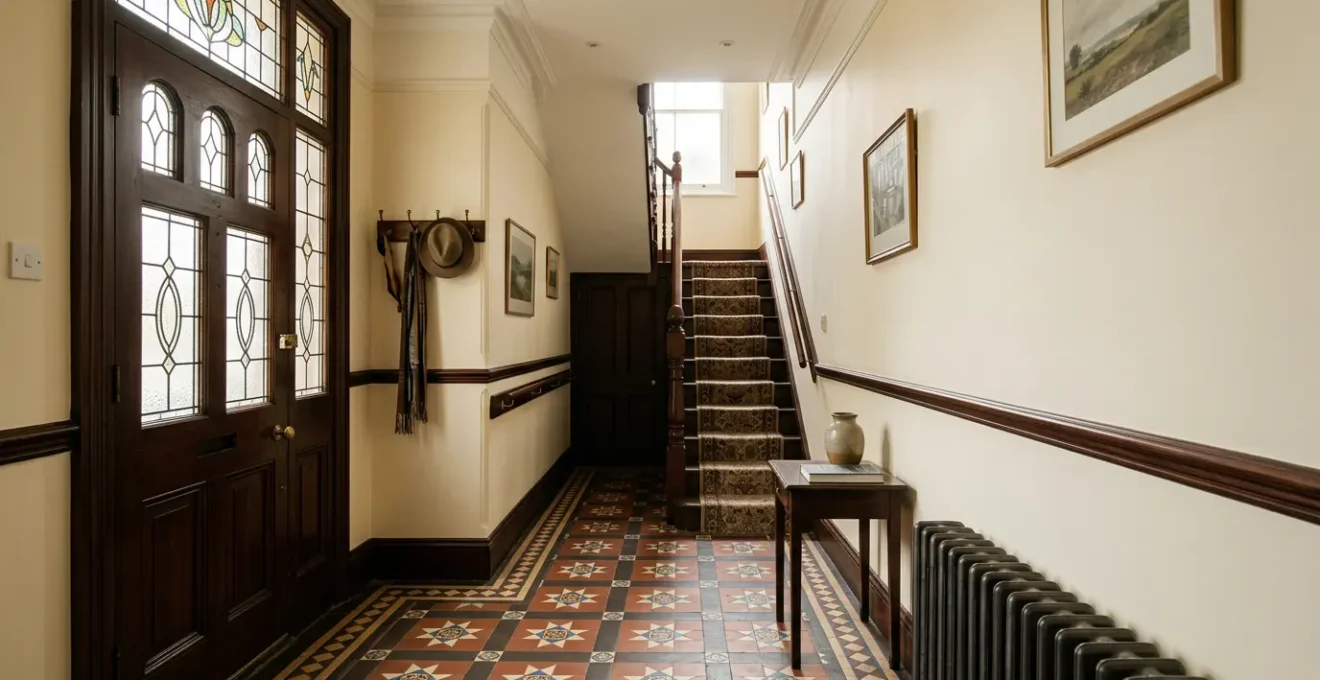
The traditional British hallway, particularly in Victorian and Edwardian homes, is a paradox. While architecturally charming with its high ceilings and original Minton tiles, its fundamental design is often at odds with the needs of an ageing resident. These spaces are typically long, narrow, and poorly lit, creating a perfect storm of risk factors for falls, a significant concern given that in the UK, 1 in 2 people aged over 80 will have at least one fall per year.
The primary issue is often a combination of insufficient lighting and visual clutter. Original designs rarely accounted for modern electrical needs, leaving many hallways with a single, often dim, ceiling pendant. This creates areas of deep shadow, especially near doorways and stairs, masking potential trip hazards like rugs, thresholds, or items left on the floor. The long, straight perspective can also create a ‘tunnel effect’ which can be disorienting, particularly for those with deteriorating eyesight or balance issues.
Furthermore, these hallways often serve as unintentional storage areas. A console table, a shoe rack, or a coat stand can constrict an already narrow passage, forcing a person to twist or turn in a way that can easily lead to a loss of balance. The lack of walls to brace against in the central part of the hallway means that a minor stumble can quickly become a major fall. The transition between different flooring materials, such as from original tiles in the hall to carpet in the living room, can also create a subtle but dangerous change in level. Addressing these inherent design flaws with improved, layered lighting and a ruthless decluttering strategy is the first and most critical step in fall prevention.
How to install a non-intrusive monitoring system in a period property?
The idea of a « monitoring system » can conjure images of intrusive cameras and clinical-looking alarms, which feels completely at odds with the aesthetic of a period home. However, the future of in-home support lies in passive, non-intrusive technology. The principle of architectural integration is key: technology should be felt, not seen. The goal is to gather crucial safety information without making the resident feel like they are under surveillance.
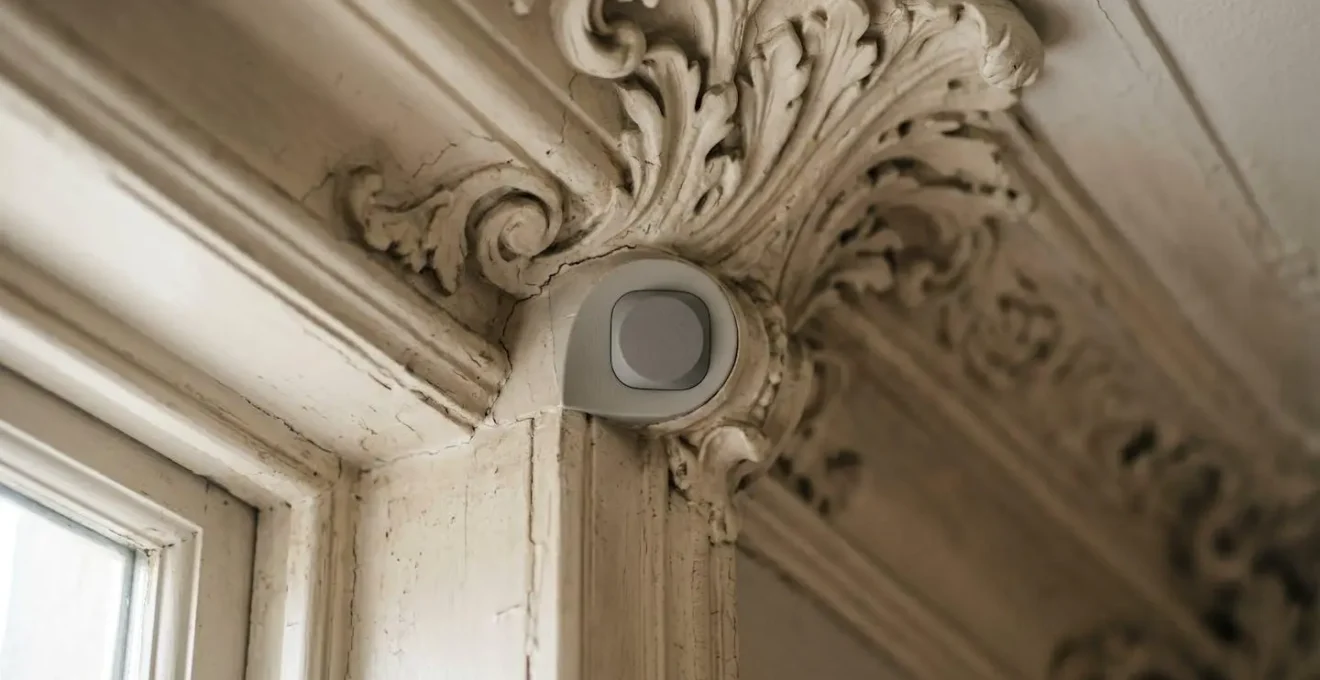
Modern passive infrared (PIR) sensors and motion detectors are now incredibly small and can be discreetly concealed. Instead of placing a bulky unit on a wall, an architect or specialist installer will look for opportunities to hide them within the existing fabric of the building. This might include placing a sensor in the ‘shadow gap’ of a deep skirting board, recessing it into the side of a bookshelf, or integrating it within an ornate ceiling cornice or picture rail. The wiring can often be channelled behind these features, rendering the entire system almost invisible.
This network of discreet sensors doesn’t watch; it learns patterns. The system understands a person’s typical routine—when they get up, when they use the kitchen, how long they usually spend in the bathroom. It’s the deviation from these patterns that triggers a discreet alert to a family member or caregiver. For example, a lack of movement in the morning, or the bathroom light being on for an unusually long time, can signal a potential issue. This approach provides peace of mind for families while completely preserving the resident’s privacy and the home’s historic character.
Stairlift vs moving to a bungalow: which makes more financial sense after 75?
For many living in a multi-story Victorian home, the staircase eventually becomes the primary obstacle to ageing in place. The decision often boils down to a stark choice: install a stairlift or sell the cherished family home and downsize to a bungalow. While a stairlift appears to be the cheaper and less disruptive option, a purely financial comparison reveals a more complex picture. A stairlift is not an investment; it is a consumable mobility aid with a limited lifespan and almost no resale value.
The upfront cost is significant; while a basic straight model can be installed for around £2,000, the complex, curved staircases common in Victorian properties require custom-built rails, pushing costs to £5,000 or more. According to a consumer survey, the average price of a stairlift in the UK is £3,867. Added to this are annual servicing costs, which are essential for safety and reliability. A stairlift can also make the property less attractive to younger buyers, who may see it as a feature to be removed at their own expense.
When considering downsizing, the initial transactional costs—stamp duty, legal fees, and moving expenses—can easily exceed £10,000. However, this move often unlocks a significant amount of capital from the original, larger property. Furthermore, a third, often overlooked option is the installation of a through-floor domestic lift. While the initial outlay is much higher (£15,000-£25,000), it provides full wheelchair access and can be marketed as a luxury feature that may increase the property’s value. As this detailed financial comparison shows, the « cheapest » option is not always the one that makes the most long-term financial sense.
| Option | Initial Cost | Hidden Costs | Long-term Value | Resale Impact |
|---|---|---|---|---|
| Straight Stairlift | £2,000 – £2,500 | Annual servicing £150-£200; Electricity £20-£50/year | Immediate mobility solution; 10-15 year lifespan | May reduce appeal to younger buyers; easily removable |
| Curved Stairlift | £5,000 – £6,000 | Annual servicing £200-£250; Custom rail non-transferable | Tailored solution; same lifespan | Negligible resale value; property-specific |
| Through-floor Lift | £15,000 – £25,000 | Annual servicing £300-£500; Higher electricity use | Wheelchair accessible; adds luxury appeal | Can increase property value 2-5%; marketed as a premium feature |
| Downsizing to Bungalow | £10,000 – £30,000+ (Stamp duty, legal fees, moving costs) | Emotional toll; loss of community ties; potential ongoing higher housing costs | Long-term accessibility; no stairs | N/A – new property |
The error of staying in a remote village home that leads to ‘transport isolation’
The desire to age in one’s own home is powerful and deeply felt; surveys consistently show that an overwhelming majority of older adults want to remain in their community. However, for those in beautiful but remote village locations, there’s a significant danger that « ageing in place » can slowly morph into « stuck in place. » This phenomenon, known as ‘transport isolation’ or ‘transport poverty’, occurs when declining mobility or the inability to drive severs the connection to essential services and social networks.
A home that was once a peaceful retreat can become a prison when you can no longer pop to the shops, visit the GP, or meet friends for coffee without relying on others. Public transport in many rural areas is often infrequent or non-existent, and while friends and family may be willing to help, an over-reliance on them can erode a person’s sense of independence and dignity. This isolation is not just an inconvenience; it is a major risk factor for depression, cognitive decline, and poor health outcomes.
Therefore, a crucial part of future-proofing a home is not just about adapting the building itself, but about proactively strengthening its connection to the outside world. This means thinking beyond grab rails and considering how to bring services and social contact *to* the home. The focus must shift to creating a socially connected environment that can function independently of a car. This involves a combination of smart technology and practical design choices that make the home a welcoming and accessible hub for visitors and services alike.
Your action plan: Building a socially connected home
- Design an accessible entry: Install a wide (at least 36-inch), step-free doorway from the street to create easy access for visitors, delivery services, and assistive devices.
- Create a ground-floor guest WC: Add a fully accessible powder room on the main floor with a comfort-height toilet and lever taps to accommodate visitors comfortably.
- Install a video doorbell system: Enable easy communication with visitors and delivery personnel without needing to navigate to the door, enhancing both convenience and security.
- Establish a dedicated ‘communication station’: Set up a large-screen device like a smart display in a comfortable, well-lit location for daily video calls with family and friends.
- Leverage hyper-local services: Research and compile a list of contacts for volunteer driver schemes, community transport, mobile hairdressers, physiotherapists, and grocery delivery apps serving your specific area.
When to replace your bathroom suite: 3 signs your current setup is becoming dangerous
The bathroom is statistically one of the most dangerous rooms in the house for an older person. A combination of hard surfaces, water, and the need to bend and lift makes it a high-risk area for falls. Homeowners are often hesitant to replace a perfectly functional, period-style bathroom suite, but there are subtle warning signs that your current setup is becoming a liability. Recognizing them is the first step towards creating a safer space that still respects the home’s aesthetic.
The first and most critical sign is using fixtures for support. If you or a loved one find yourselves instinctively grabbing the edge of the sink to stand up from the toilet, or holding onto the towel rail to step out of the bath, it’s a clear indication that dedicated support is needed. These fixtures are not designed to bear weight and can easily come away from the wall, causing a serious fall. This is a non-negotiable red flag.
The second sign is difficulty getting in and out of the bath. A traditional Victorian roll-top bath is beautiful, but its high sides present a significant challenge. If stepping over the edge starts to feel precarious, or requires a complex manoeuvre, it’s time to consider a change. The third sign is a slippery floor surface. High-gloss period tiles, while authentic, can become treacherous when wet. If you find yourself treading with extreme caution or have had a near-slip, the risk is undeniable. The solution is not to resort to ugly, clinical aids, but to embrace the concept of an ‘aesthetic of access’, using beautifully designed, compliant products that enhance the room’s style.
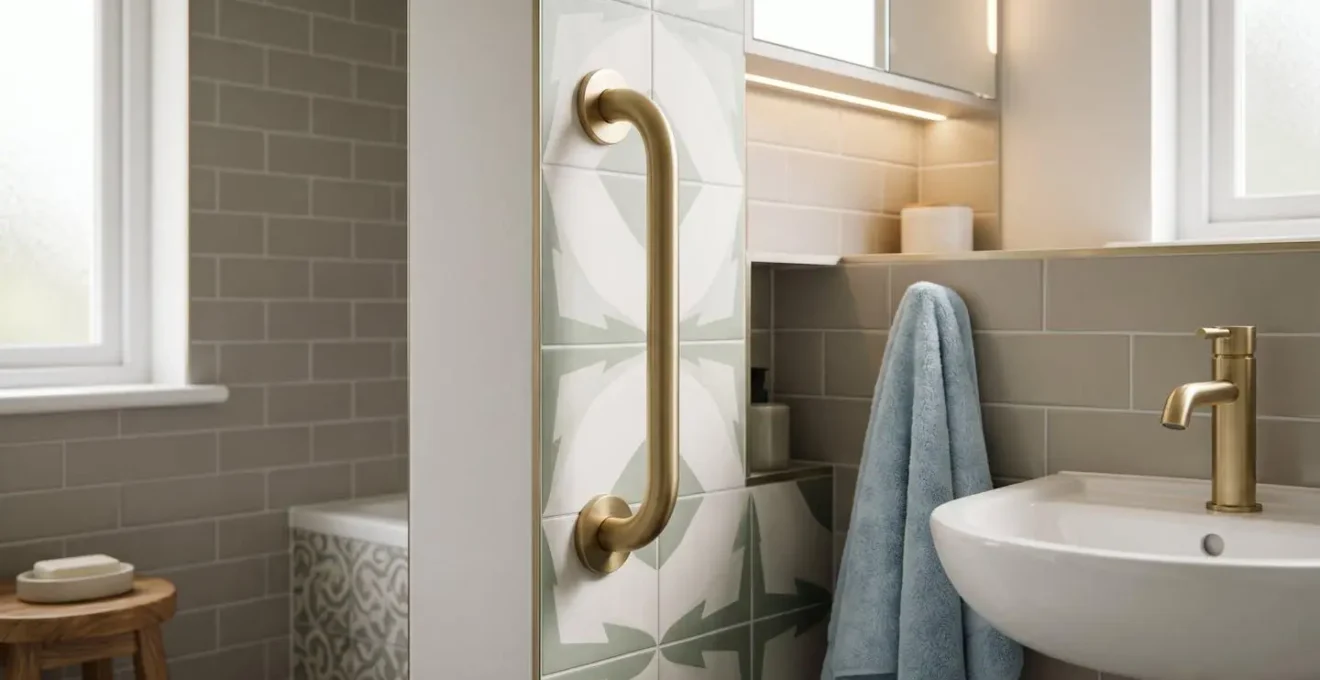
Modern design offers elegant solutions like walk-in or level-access showers with frameless glass screens that feel open and luxurious. Grab rails are now available in finishes like brushed brass or matte black that coordinate with high-end taps, appearing as stylish design features rather than medical aids. Replacing a glossy floor with modern, slip-resistant porcelain tiles that replicate a period pattern provides safety without aesthetic compromise.
How to get Part M compliance signed off for your extension?
When planning an extension or major refurbishment, homeowners will encounter Building Regulations Approved Document M, or « Part M, » which deals with the access to and use of buildings. For new dwellings, the rules are stringent, requiring features like a level-access threshold, a ground-floor WC, and specific doorway widths. However, when working with an existing period property, applying these rules rigidly is often impractical or would cause unacceptable harm to the building’s character. This is where the concept of « reasonable provision » becomes crucial.
Building Control Officers (BCOs) have a degree of discretion. They understand that you cannot easily widen the original 800mm-wide hallway of a Victorian house to the 900mm+ standard for new builds. Your architect’s job is to negotiate with the BCO, demonstrating that you are making every reasonable effort to improve accessibility within the constraints of the existing structure. The key is to be proactive and present a clear justification for any areas of non-compliance, alongside a robust proposal for compensatory measures.
This means if you cannot achieve a perfectly compliant feature in one area, you compensate by exceeding the standard elsewhere. For example, if widening a period doorway is impossible without major structural work, you might propose installing a fully compliant, larger accessible WC, enhanced lighting throughout the access route, and ensuring a completely level threshold to offset the slightly narrower door. This demonstrates a commitment to the spirit of Part M, even if the letter of the law cannot be met in every detail.
Case Study: Negotiating ‘Reasonable Provision’ in Practice
An architect specializing in accessibility notes that while many homeowners overlook age-proofing during remodels, Building Control Officers are increasingly flexible. The key is a clear justification statement explaining why certain period features cannot be altered and detailing compensatory measures. For example, one homeowner successfully negotiated approval for an 800mm doorway (instead of the ideal 900mm) by demonstrating a completely level threshold, enhanced lighting, and a fully compliant accessible WC elsewhere in the extension. This holistic approach to accessibility proved that reasonable provision was being made.
Why does the council surveyor reject your request for a Jacuzzi bath?
The Disabled Facilities Grant (DFG) is a vital, means-tested grant provided by local councils to help disabled people adapt their homes. It can be a lifeline, funding essential changes like stairlifts, level-access showers, and door widening. However, there is a common and fundamental misunderstanding of its purpose, which often leads to disappointment and rejected applications. The DFG is designed to meet assessed needs, not personal wants.
When you apply for a DFG, an Occupational Therapist (OT) will visit your home to assess your specific situation. Their recommendation to the council is based on what is « necessary and appropriate » to help you manage essential daily activities, such as bathing, using the toilet, and moving safely around your home. The grant can provide up to £30,000 in England and £36,000 in Wales for these necessary adaptations, but the key word is ‘necessary’.
A request for a Jacuzzi or whirlpool bath is almost certain to be rejected because it is viewed as a luxury item, not an essential piece of mobility equipment. While you might argue it has therapeutic benefits, the OT’s primary concern is safe access. Their solution will be the most cost-effective one that meets the assessed need, which is typically a level-access shower or a walk-in bath with a powered seat. These items directly address the difficulty of getting in and out of a standard bath. A Jacuzzi does not. You are free to install a Jacuzzi at your own expense, but you cannot use public funds designated for essential adaptations to pay for it. The council surveyor’s role is to approve the most practical and economical solution to the problem identified by the OT.
Key Takeaways
- Integration over Addition: The most successful adaptations are those seamlessly integrated into the home’s architecture, preserving its character while enhancing safety.
- Analyse the True Cost: When comparing options like a stairlift versus moving, look beyond the initial price to consider servicing costs, property value impact, and long-term suitability.
- ‘Broken-Plan’ for Better Living: For seniors, a ‘broken-plan’ layout, which uses subtle zoning, is often functionally and psychologically superior to a fully open-plan space.
How to create a truly open-plan ground floor in a UK semi-detached house?
For decades, the « open-plan » concept has been the go-to solution for modernising the typically segregated ground floor of a Victorian or Edwardian home. The dream is a bright, flowing space, perfect for socialising. However, for an ageing resident, a vast, fully open-plan area can be surprisingly problematic. The lack of walls removes crucial handholds for support and stability, noise can become overwhelming and confusing, and the absence of defined zones can feel psychologically unsettling.
From an architectural standpoint, creating this space is a significant structural undertaking. It involves removing load-bearing walls and installing substantial steel beams (RSJs) to support the upper floors and roof, a process that requires careful engineering calculations and approval from Building Control. While achievable, it’s an expensive and disruptive process.
A more sophisticated and often more suitable approach for ageing in place is the concept of « broken-plan » design. This philosophy maintains the sense of light and space associated with open-plan living but reintroduces subtle divisions to create defined zones and restore a sense of security and structure. It’s the perfect compromise between the cellular rooms of the past and the boundary-free spaces of today.
Case Study: The ‘Broken-Plan’ Alternative
Design professionals increasingly recommend ‘broken-plan’ layouts for older adults. Rather than removing all walls, this approach uses strategic zoning. For example, the original chimney breast can be preserved as a natural divider between living and dining areas, providing a solid structure for support. Glazed internal partitions or Crittall-style screens can separate a kitchen from a living space without blocking light. Using different flooring materials (ensuring they are all at the same level) can also visually demarcate zones. This approach maintains openness while providing walls for support during movement, reducing noise, and creating defined spaces that feel more secure.
This intelligent design provides the best of both worlds: a home that feels connected and spacious, but also offers the physical and psychological support needed for confident, independent living. It is the ultimate expression of adapting a period home with both sensitivity and foresight.
By shifting your perspective from simply adding aids to thoughtfully integrating solutions, you can create a home that is not only safer but also more beautiful and comfortable. The next logical step is to consult with an architect who specialises in inclusive and period-property design to develop a phased, long-term masterplan for your home.