

Forget the standard ‘job description’ that lists generic tasks. To truly maintain your independence and lifestyle, you must craft a detailed ‘Lifestyle Specification’ for your carer. This document shifts the focus from completing activities to achieving specific, meaningful outcomes that preserve the personal rituals, preferences, and rhythms of your day. It transforms a carer from a mere task-doer into a facilitator of your established life, ensuring your world remains yours.
The prospect of bringing a carer into your home often comes with a significant fear: the loss of control over your own life. You have spent decades cultivating specific habits, routines, and small rituals that make your house a home. The way you take your tea, the order of your morning paper, the precise arrangement of your kitchen—these are not trivial details; they are the very fabric of your daily existence. The standard advice is to create a ‘job description’ or a ‘care plan’, which usually devolves into a clinical list of Activities of Daily Living (ADLs). This approach is fundamentally flawed because it focuses on tasks, not on life.
This traditional, task-based model is where care often fails the individual. It addresses the ‘what’ (medication, meals, bathing) but completely ignores the ‘how’, the personal nuance that defines your quality of life. But what if the entire framework could be shifted? What if, instead of a checklist of duties, you provided a blueprint for preserving your lifestyle? This is the power of moving from a task-based mindset to an outcome-oriented one.
The core principle is this: you are not hiring an employee to perform chores; you are engaging a professional to facilitate your preferred way of life. This requires a new kind of document—a Lifestyle & Routine Specification. This document goes beyond a simple list. It details the desired outcomes, the sensory anchors of your day (the smell of coffee brewing at a specific time, the quiet of the afternoon), and the non-negotiable elements of your personal culture. It’s about ensuring your independence is not just supported, but respected in its every detail.
This guide will walk you through the process of creating this powerful document. We will explore the fundamental difference between task-based and outcome-based care, provide practical solutions for adapting your environment, and offer frameworks for structuring your days and weeks. The goal is to empower you to articulate your needs with such precision that any carer stepping into your home understands their primary role: to be a guardian of your routine and a facilitator of your independence.
To help you navigate this new approach, this article is structured to build from the core philosophy to its practical, daily applications. Here is a summary of the key areas we will cover.
Summary: Crafting a Carer Briefing That Protects Your Routine
- Why does ‘task-based’ care fail to improve quality of life compared to ‘outcome-based’ care?
- How to modify kitchen tools for arthritic hands without buying expensive gadgets?
- Meals on Wheels vs private meal prep services: which tastes better and offers nutrition?
- The error of letting a carer do everything, which accelerates physical decline
- When to introduce a ‘sleeping night’ carer: the signals that safety is compromised
- How to link medication taking to the ‘cup of tea’ habit?
- How to create a weekly schedule that balances rest and activity after 65?
- How to design a fulfilling retirement routine in the UK without spending a fortune?
Why does ‘task-based’ care fail to improve quality of life compared to ‘outcome-based’ care?
The fundamental flaw in most conventional care plans is their focus on tasks rather than outcomes. A task-based approach treats a person like a project to be managed, with a checklist of items to be ticked off: ‘Administer medication at 8 AM’, ‘Prepare lunch at 12 PM’, ‘Assist with bathing at 6 PM’. While these tasks are completed, this model often fails to address the individual’s psychological, emotional, and social well-being. It can make the recipient of care feel like a passive object in their own life, leading to a diminished sense of agency and a lower quality of life.
In contrast, outcome-based care redefines the objective. The goal isn’t just to ‘administer medication’, but to ‘ensure medication is taken calmly and consistently, turning a clinical necessity into a reassuring daily ritual’. The focus shifts from the action itself to the result it produces for the person’s well-being. This approach requires the carer to be a thoughtful problem-solver rather than a robotic functionary. It empowers them to use their skills to achieve a meaningful goal, fostering a stronger connection and a sense of professional pride.
For you, the senior, the difference is profound. It’s the difference between being handed a plate of food and being a participant in a pleasant mealtime experience. An outcome-focused plan is inherently person-centred. It asks, « What does a successful day look like and feel like for you? » and then works backward to define the support needed to achieve that. This respects dignity, promotes autonomy, and, as studies suggest, significantly improves overall health-related quality of life.
This table illustrates the critical differences in approach and impact, based on a framework for understanding care quality. It clearly shows how focusing on outcomes can transform the experience for both the senior and the carer, as detailed in an analysis of health care quality improvement.
| Care Approach | Focus | Example Description | Impact on Quality of Life | Carer Experience |
|---|---|---|---|---|
| Task-Based Care | Completing predefined activities | ‘Administer medication at 8 AM’ | Addresses physical needs but may miss emotional and psychological requirements | Can lead to burnout and sense of being robotic |
| Outcome-Based Care | Achieving meaningful results for the person | ‘Ensure medication is taken calmly and consistently, turning a clinical necessity into a reassuring daily ritual’ | Improves health-related quality of life across physical, psychological, and social domains | Fosters professional pride, problem-solving, and stronger personal connection |
Ultimately, insisting on an outcome-based specification is the first and most critical step in ensuring your care plan is a tool for life enhancement, not just a schedule of tasks.
How to modify kitchen tools for arthritic hands without buying expensive gadgets?
Maintaining involvement in the kitchen is a powerful anchor for independence and routine. However, arthritis or reduced grip strength can turn simple tasks like chopping vegetables or opening a jar into painful challenges. The market is flooded with expensive, specialized « adaptive » gadgets, but the true spirit of maintaining your lifestyle often lies in cleverly modifying the familiar tools you already own and love. This approach is not only cost-effective but also reinforces your ability to problem-solve and adapt your own environment.
The core principle is to increase handle diameter and improve grip. A larger, softer surface requires less finger-joint pressure and muscle force to hold securely. This can be achieved with simple, inexpensive materials from a hardware or craft store. For instance, foam pipe insulation is a perfect, lightweight material for building up the handles of cutlery, knives, and other utensils. It’s easily cut to size and provides a comfortable, padded grip that can reduce joint pressure significantly.
This paragraph introduces the concept of DIY adaptations. To better understand this, the image below shows a simple yet effective modification using common materials.
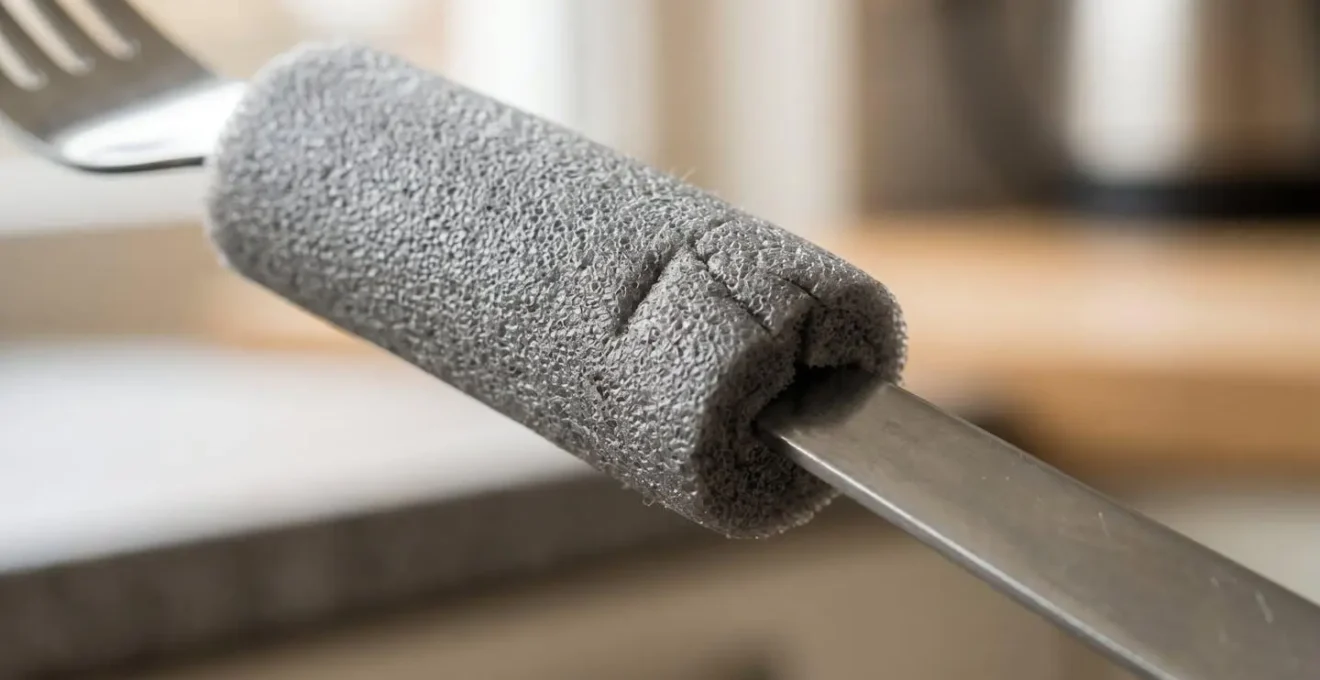
As this image demonstrates, the modification is straightforward. Other effective ‘hacks’ include wrapping rubber bands around jar lids to increase friction or using a simple damp washcloth for extra torque. The goal is to specify in your carer briefing that their role is not to take over these tasks, but to assist in implementing these modifications, empowering you to continue participating in activities you enjoy. The carer becomes a facilitator of your capability, not a replacement for it.
- Build up handle diameter: Wrap foam pipe insulation, shelf liner strips, or layers of self-adhering bandage wrap around utensil handles. According to some ergonomic studies, increasing the diameter by just a quarter inch can substantially reduce joint pressure.
- Increase friction and grip: Add textured materials like rubber bands around jar lids or silicone strips around pan handles.
- Use leverage principles: Replace twist-top containers with lever-style alternatives; use longer-handled tools to increase mechanical advantage.
- The washcloth hack: For a zero-cost solution, simply wrap a folded washcloth around a tool handle to instantly increase its diameter and cushion your grip.
By focusing on these simple, low-cost adaptations, you maintain control over your environment and direct your carer to support your continued engagement, rather than foster dependence.
Meals on Wheels vs private meal prep services: which tastes better and offers nutrition?
Food is central to our quality of life, tied to routine, comfort, and sensory pleasure. When considering meal support, the choice often appears to be between subsidized services like Meals on Wheels and more expensive private meal preparation services. The decision is not merely about nutrition or cost; it’s about which service model best aligns with your desire for personalization, freshness, and the overall dining experience. Understanding the trade-offs is key to making a choice that supports your lifestyle.
Meals on Wheels is a vital service, primarily focused on tackling food insecurity and social isolation. The meals are designed to be nutritionally sound, typically meeting at least one-third of daily nutrient requirements, and are often low in sodium and sugar. Its greatest, and often understated, benefit is the daily wellness check and social interaction provided by the volunteer driver. However, customization is generally very limited, making it a less-than-ideal solution if you have specific dietary needs or simply particular tastes.
Private meal prep services, while more expensive, are built on a foundation of personalization. They operate on the principle of outcome-based care: the goal isn’t just to deliver a meal, but to create a delicious, satisfying, and nutritionally tailored dining experience. A private chef can use your own family recipes, accommodate complex overlapping dietary restrictions, and use fresh, high-quality ingredients. Furthermore, the experience of having meals prepared in your own home brings the comforting aromas and sensory engagement of cooking back into your life—a significant but often overlooked aspect of well-being.
This comparative table highlights the key differences, helping you weigh the factors that matter most to you. The data is synthesized from information provided by both types of services, including a leading private meal service provider.
| Criterion | Meals on Wheels | Private Meal Prep Services |
|---|---|---|
| Meal Freshness | Usually warm and ready-to-eat when delivered, or frozen meals requiring microwave | Fresh ingredients, never frozen, prepared in client’s kitchen |
| Nutritional Design | Meals meet at least one-third of daily nutrient requirements; low in sodium and sugar but not customizable for specific diets | Fresh, healthy ingredients ensure higher nutrition; fully customizable for dietary restrictions and preferences |
| Cost | Free or low-cost ($5-$10 per meal), subsidized by Older Americans Act and private donors | More expensive; not covered by Medicare/Older Americans Act but may be paid via Long-Term Care insurance |
| Social Experience | Brief daily wellness check and social interaction from volunteer driver | Extended companionship during cooking visit; weekly friendly interaction to look forward to |
| Customization | Limited ability to accommodate specific food preferences or complex dietary needs | High personalization including family recipes, off-menu flexibility, and overlapping dietary requirements |
| Cooking Aromas & Engagement | No cooking smells or sensory experience in the home | Comforting cooking aromas and potential for senior to participate in meal assembly |
Your choice will depend on your budget, your health insurance, and what you value more: the low-cost, reliable nutrition and social check-in of a community service, or the highly personalized, sensory-rich experience of a private service.
The error of letting a carer do everything, which accelerates physical decline
One of the most pervasive and dangerous misconceptions in care is that the carer’s role is to do everything *for* the senior. While born from a place of good intentions—to make life easier and prevent accidents—this approach of « learned helplessness » can be profoundly detrimental. When a carer systematically takes over tasks that a person is still capable of performing, even if slowly or with difficulty, they inadvertently accelerate physical and cognitive decline. The adage « use it or lose it » is a stark physiological reality.
Every time you reach for a cup, stand up from a chair, or walk to the kitchen, you are engaging muscles, challenging your balance, and reinforcing neural pathways. When a carer does these things for you, your body is deprived of these essential micro-workouts. This leads to faster muscle atrophy, decreased cardiovascular health, and a greater risk of falls. The very outcome the over-helpful carer is trying to prevent—a fall—becomes more likely. This cycle of decline can be devastating, as the National Council on Aging points out.
As an authority on aging well, the National Council on Aging highlights the psychological impact in their « Get the Facts on Healthy Aging » guide:
Fear of falling can lead older adults to limit their activities, which can result in more falls, further physical decline, depression, and social isolation.
– National Council on Aging, Get the Facts on Healthy Aging
Therefore, your Lifestyle Specification must be explicit about this. It should clearly define the carer’s role as a facilitator of your activity, not a replacement for it. Your instructions should be framed as « stand by for balance support while I walk to the dining room, » not « bring me to the dining room. » Or « prepare the ingredients so I can assemble the salad, » not « make the salad. » This maintains your physical engagement and, just as importantly, your sense of purpose and control over your own actions. It redefines the dynamic as a partnership for maintaining capability, not a service for managing disability.
Insisting on this collaborative approach is non-negotiable. It is the single most effective way to ensure that your care arrangement actively works to preserve your strength and independence for as long as possible.
When to introduce a ‘sleeping night’ carer: the signals that safety is compromised
The decision to introduce overnight care is a significant one, often marking a major shift in the level of support required. It’s a step many are reluctant to take, as it can feel like a profound loss of privacy and independence. However, the decision should not be driven by emotion but by a clear-eyed assessment of safety. Uninterrupted, restorative sleep is critical for daytime function, and night-time falls or medical events can have catastrophic consequences. Recognizing the subtle but clear signals that night-time safety is compromised is essential.
These signals are often not dramatic. They can be an increase in anxiety specifically about being alone at night, a rise in the number of trips to the bathroom that increase fall risk, or the appearance of unexplained bruises in the morning. A key indicator is a noticeable increase in daytime fatigue or napping, which often points to poor quality, fragmented night-time sleep. The need for assistance is a normal part of the aging process for many; in fact, research shows that 40 to 53 percent of individuals over the age of 85 require assistance with activities of daily living. Acknowledging this need for night-time safety is a proactive, not a negative, step.
A « sleeping night » carer is a specific arrangement where the carer is present in the home and sleeps in a separate room, available to be woken up once or twice during the night for assistance. This provides a crucial safety net without the full intrusion of an « awake night » carer. It offers peace of mind, knowing help is immediately available for a bathroom visit, a moment of disorientation, or a medical concern.
The environment must be prepared to be both safe and dignified. The image below depicts a bedroom that integrates safety features in a warm, non-clinical setting.

Your Night-time Safety Audit Checklist: Key Signals to Monitor
- Track the number of bathroom trips during the night over a one-week period to identify patterns and risks.
- Document any unexplained bruises or marks that appear in the morning, which could indicate unreported falls or stumbles.
- Monitor for increased daytime napping, as this may be a direct result of poor quality or interrupted night-time sleep.
- Note any expressions of anxiety specifically about being alone at night or fears of falling when getting out of bed.
- Observe for any decline in morning personal hygiene or grooming, which can be a sign of overnight fatigue and low energy.
By systematically monitoring these signals, you can make an objective, data-driven decision about when a sleeping night carer becomes a necessary component of your safety and well-being plan.
How to link medication taking to the ‘cup of tea’ habit?
Medication adherence is a cornerstone of managing health in later life, yet it can be a source of constant stress and friction. Forgetting a dose or taking it at the wrong time can have serious consequences. The key to consistency is not willpower or constant reminders, but a clever psychological technique known as « habit stacking. » This involves linking the new habit you want to form (taking medication) to an existing, deeply ingrained habit that you perform automatically, like making your daily cup of tea.
The « cup of tea » is more than a beverage; it’s a ritual. It has a specific time, a specific sequence of actions, and a specific sensory experience. This makes it a perfect « anchor » for your medication routine. The goal is to seamlessly weave the act of taking pills into the fabric of this enjoyable ritual, transforming it from a clinical chore into a natural part of a pleasant moment. This is a perfect example of an outcome-based directive for your carer: the outcome is not ‘pills taken,’ but ‘medication seamlessly and pleasantly integrated into the afternoon tea ritual’.
The implementation requires thoughtful design of your environment and the process. It’s about eliminating decision fatigue and making the sequence as frictionless as possible. The carer’s role is to set the stage for this to happen automatically. This might involve creating a dedicated « medication station » on a tray, holding your special teacup, the pill organizer, and a glass of water, all in one place. The process becomes a small, shared moment of connection rather than a moment of medical oversight.
Here is a practical framework for implementing the habit stacking method, which you should detail in your Lifestyle Specification:
- Apply the formula: State the rule clearly: « After I fill the kettle for my afternoon tea, I will get my pill organizer from the counter. »
- Create a Visual Cue Station: Use a dedicated, uncluttered tray that holds the teacup, pill organizer, and a glass of water in one consistent, visible location.
- Design the Ritual Integration: Have the carer prepare the tea while you retrieve your pills. This turns a solo task into a brief, 5-minute moment of connection. Using a special ‘medication mug’ can also create a strong sensory anchor.
- Build If-Then Resilience: Plan for exceptions. « If I don’t want my afternoon tea today, then we will link the medication to watching my 3 PM favourite TV show instead. » This creates flexibility without breaking the routine.
- Eliminate decision fatigue: Place all required items (kettle, pills, cup, water) within arm’s reach to reduce cognitive load and make the sequence automatic.
By using this method, you are not just managing your medication; you are redesigning your routine to make healthy behaviours automatic, effortless, and even enjoyable.
How to create a weekly schedule that balances rest and activity after 65?
Retirement should not be an unstructured void but a canvas for a new, purposeful life. However, creating a fulfilling weekly schedule is a delicate balancing act. Too little activity can lead to physical decline and social isolation, while too much can lead to exhaustion and burnout. The challenge is particularly acute given that, according to 2018 Physical Activity Guidelines for Americans, only 23.1% of adults aged 65 and over met the federal recommendations for physical activity. The key is to move away from a rigid timetable and adopt a more fluid concept of « energy budgeting. »
Energy budgeting treats your available daily energy as a finite resource, much like a financial budget. Some activities (like a doctor’s appointment or a busy social outing) are « high-cost, » while others (like reading in the garden or gentle stretching) are « low-cost » or even « restorative. » The goal is to plan your week to ensure you don’t end up in « energy bankruptcy » by scheduling too many high-cost activities back-to-back without sufficient time for recovery. This framework allows for a more realistic and sustainable pace of life.
Your Lifestyle Specification should introduce this concept to your carer, defining their role as a co-manager of this energy budget. This involves not just following a schedule, but understanding the energy demands of each activity and helping you make adjustments. For example, if a high-energy activity is planned for Tuesday, Wednesday should be scheduled with low-energy, restorative activities. This ensures a balanced rhythm that prevents over-exertion and preserves your enjoyment of life.
A practical way to implement this is through a structured framework:
- Assign an ‘energy score’ (1-5) to each planned activity: This helps you visualize the week’s energy expenditure and avoid overloading any given day or week.
- Apply Theme Days: For example, Monday = Home & Organisation Day; Tuesday = Social & Outing Day; Wednesday = Hobbies & Creativity Day. This creates a predictable rhythm and reduces daily decision fatigue.
- Schedule ‘Spontaneous Time’: Block out periods with no predetermined plan. This is crucial for preserving autonomy and joy. Your carer’s role during this time must be specified as ‘facilitator, not director’.
- Balance high-energy and low-energy activities: Always follow demanding activities with restorative periods, either on the same day or the next.
- Use a Well-being Wheel planner: Divide your weekly time across different dimensions—Social, Physical, Mental, Spiritual, and Rest—to ensure no aspect of a fulfilling life is neglected.
By adopting an energy budgeting approach, you create a schedule that is not just a list of appointments, but a dynamic, responsive tool for living a balanced, active, and fulfilling life after 65.
Key takeaways
- Shift from a ‘task list’ to a ‘Lifestyle Specification’ that defines desired outcomes, not just activities.
- The carer’s role should be a ‘facilitator’ who enables your independence, not a ‘doer’ who creates dependence.
- Use ‘habit stacking’ to link necessary tasks like medication to enjoyable daily rituals, such as your afternoon tea.
How to design a fulfilling retirement routine in the UK without spending a fortune?
Designing a fulfilling retirement is often mistakenly linked with a significant budget for travel, hobbies, and entertainment. However, true fulfillment stems from purpose, connection, and contribution, all of which can be cultivated with minimal financial outlay. This is particularly important given that, according to data on economic stability, nearly 1 in 10 older adults in the United States lives in poverty, a challenge mirrored in many Western countries including the UK. The secret lies in leveraging hyperlocal opportunities and building a ‘Purpose Portfolio’.
A ‘Purpose Portfolio’ is a balanced collection of activities that nourishes different aspects of your well-being. It’s a strategic approach to structuring your time that ensures you are not only staying healthy and engaged but also contributing to your community and maintaining a sense of value. Your carer’s role, as defined in your Lifestyle Specification, is to help you manage and access the resources needed for this portfolio, whether it’s providing transport to a volunteer location or helping you set up a video call for an online course.
The UK offers a wealth of free or low-cost resources for seniors. Organisations like the University of the Third Age (U3A) provide peer-led learning groups on virtually any subject imaginable. Local councils run free exercise classes, and charities like The National Trust offer free entry days to their properties. The key is to be proactive and intentional in seeking out these opportunities. Launching ‘hyperlocal adventures’—becoming an expert on your own neighbourhood’s history, mapping accessible walking routes, or simply becoming a valued regular at a local café—builds deep community ties without costing a penny.
This framework provides a roadmap for building a rich and varied retirement routine:
- Build a Purpose Portfolio: Cultivate one activity that makes/saves money (e.g., selling produce from a small garden), one that keeps you healthy (e.g., council-run tai chi), one that feeds your creativity (e.g., joining a library book club), and one that contributes to your community (e.g., volunteering).
- Launch Hyperlocal Adventures: Become a local historian through walks and photography, volunteer at the local library, or start a skill-swap group in your building.
- Leverage Skill Swap and Time Banking: Exchange your lifetime of expertise (accounting, gardening, sewing) for services you need, creating a rich social network without spending money.
- Utilize UK-specific free resources: Actively explore National Trust free days, join a local U3A group, and inquire about council-run exercise classes or events for seniors.
By focusing on this portfolio approach, you can design a retirement that is not just affordable, but rich in purpose, connection, and genuine satisfaction, proving that the best things in life are indeed often free.