
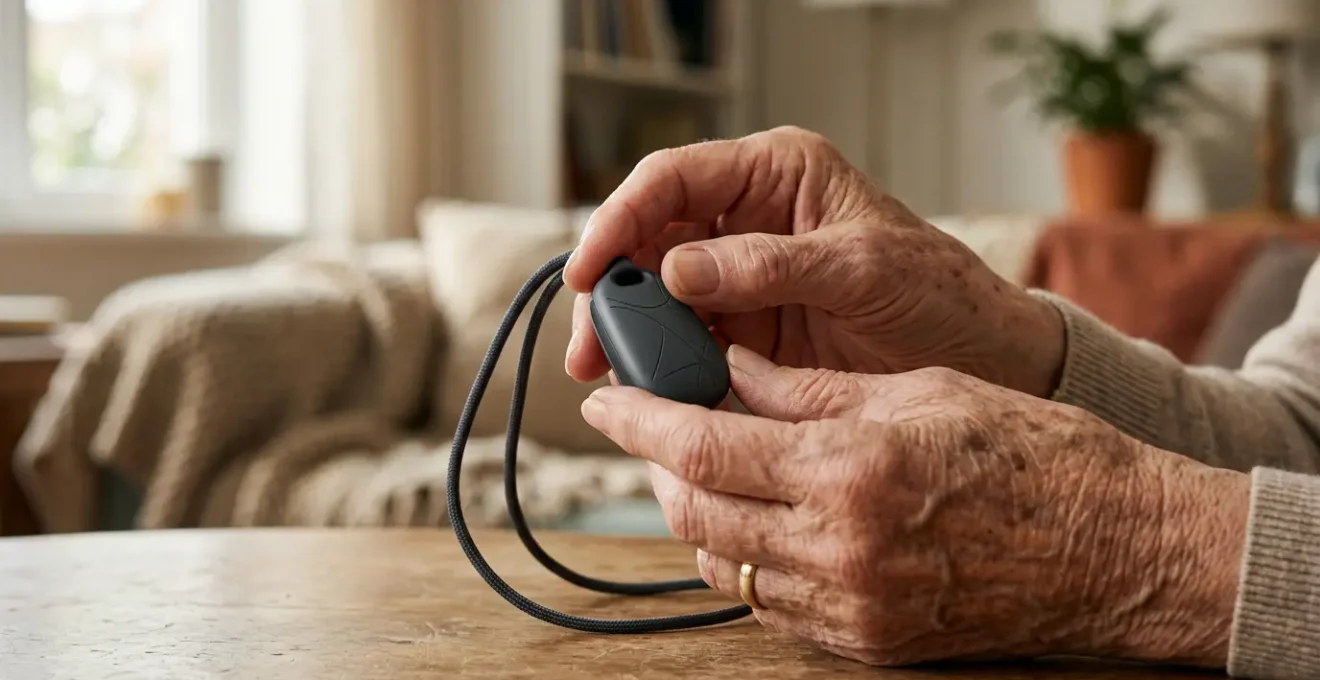
The accuracy of a fall detector isn’t magic; it’s a result of multi-sensor data analysis that creates a unique « algorithmic signature » for a genuine fall.
- Algorithms differentiate between a sudden impact (a fall) and a controlled descent (sitting) by analyzing velocity, orientation, and post-event immobility.
- Device placement is critical; a central body location (pendant or waist) provides a clearer signal of whole-body movement than a wrist.
Recommendation: Focus on devices that use multi-sensor fusion (accelerometers + gyroscopes) and understand that they are one part of a larger safety system that includes professional assessment and environmental awareness.
The central anxiety surrounding fall detection technology is one of trust. A senior, or their family, often faces a dual-edged fear: « Will it trigger a false alarm while I’m gardening? » and, more critically, « Will it fail to detect a real fall when I need it most? » This skepticism is understandable, especially when the underlying technology is perceived as a simple motion sensor, prone to errors from any sudden jolt or quick movement, like sitting down abruptly.
Many conventional explanations stop at the surface, mentioning accelerometers and impact detection. This limited view feeds the narrative of unreliability. However, from a sensor technology engineer’s perspective, this is a fundamental misunderstanding of how modern systems operate. The true innovation lies not in a single component, but in the sophisticated interplay of multiple sensors and the intelligent software that interprets their combined data stream.
The key is understanding that these devices are not just measuring impact; they are performing a constant contextual analysis of movement. They are trained to recognise the specific algorithmic signature of a fall—a complex pattern of velocity, orientation change, and post-event behaviour that is distinct from thousands of other daily activities. This is achieved through multi-sensor fusion, a process that combines data from different sensors to paint a highly accurate picture of the body’s motion in three-dimensional space.
This article will deconstruct the engineering principles behind fall detection. We will move beyond the marketing claims to explore the core technology, explain why some falls are harder to detect than others, and provide the technical knowledge needed to evaluate and trust these life-saving devices. By understanding the logic of the machine, users can gain confidence in the protection it offers.
To navigate this technical landscape, the following guide breaks down the most critical questions and engineering challenges. Each section builds upon the last, providing a comprehensive understanding of how these devices function and how to use them effectively as part of a complete safety strategy.
Summary: Understanding the Core Engineering of Fall Detection Accuracy
- Why do most detectors fail to register a ‘sliding’ fall from a chair?
- How to find a wandering senior who has fallen outside the home?
- Wristband or pendant: which has better accuracy for arm movement interference?
- The error of taking the device off because it beeps every time you chop vegetables
- How to remember to charge a daily device when you have memory issues?
- The error of using a retractable lead that causes entanglement falls
- The mistake of treating normal aging processes as diseases requiring aggressive intervention
- How to access a Comprehensive Geriatric Assessment (CGA) in the UK?
Why do most detectors fail to register a ‘sliding’ fall from a chair?
The primary reason some detectors struggle with « soft » or « sliding » falls is rooted in their core programming. Basic algorithms are calibrated to identify a specific sequence: a rapid, high-G-force acceleration towards the ground, followed by a distinct impact, and then a period of immobility. A quick, hard fall from a standing position creates a clear and unambiguous algorithmic signature. However, a sliding fall from a chair or bed often lacks the initial high-velocity drop. The descent is more gradual, and the final impact may be cushioned, failing to cross the pre-set threshold calibration for a fall event.
This is where advanced systems demonstrate their superiority through multi-sensor fusion. As a BMC Public Health review notes, modern devices do not rely on an accelerometer alone. The research highlights that « wearable devices typically combine accelerometers, gyroscopes and even barometers; using the data collected and inputting this into an algorithm that decides whether a fall has occurred. » The gyroscope is particularly critical for detecting sliding falls. It measures orientation, not just acceleration. So, even without a hard impact, the algorithm can detect a significant, non-recoverable change in orientation—from upright to horizontal—and trigger an alert.
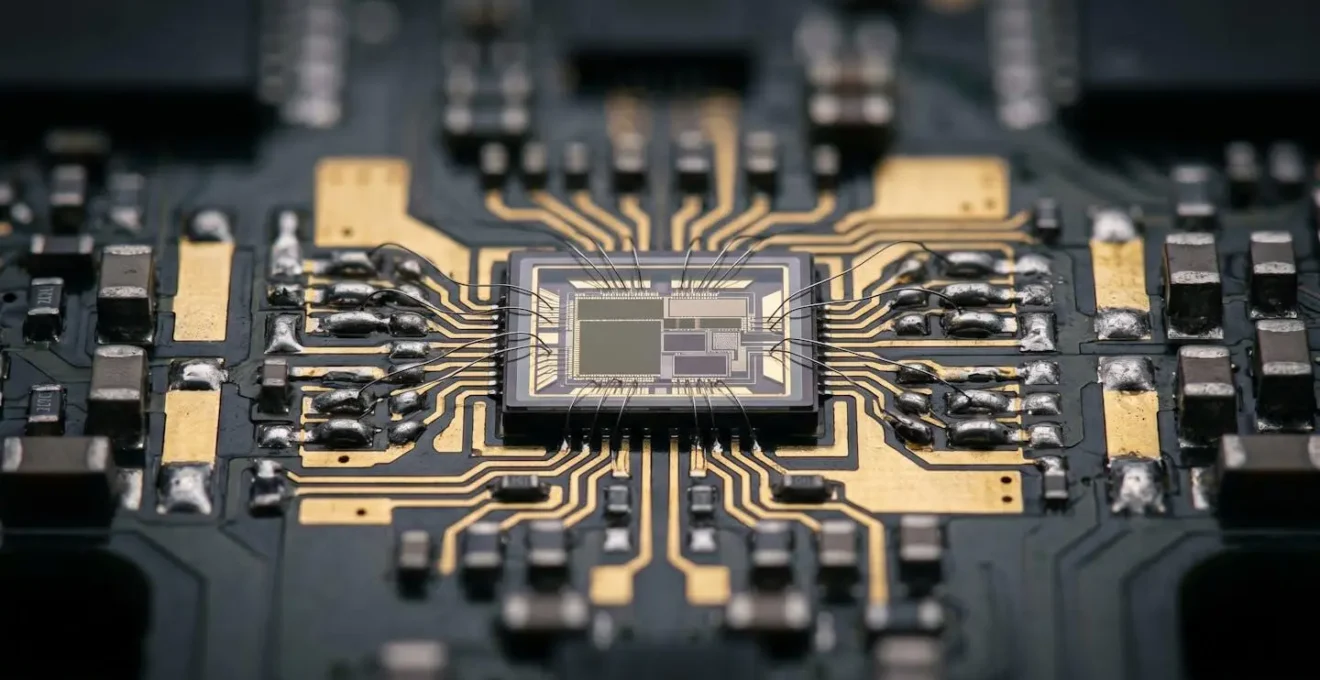
Ultimately, while some systematic reviews report that wearable fall detectors can achieve a 93.1% or greater average sensitivity for real-world falls, this high accuracy is increasingly dependent on the sophistication of the device’s sensor array and its software. For scenarios involving sliding or cushioned falls, a device featuring both an accelerometer and a gyroscope offers a much higher probability of successful detection.
How to find a wandering senior who has fallen outside the home?
When a fall occurs outside the home, especially in cases involving cognitive impairment, the challenge shifts from simple fall detection to emergency location. The core technology for this is the Global Positioning System (GPS). A fall detection device equipped with a GPS chip can, upon detecting a fall, transmit its precise geographical coordinates along with the emergency alert to a monitoring centre or designated family members. This transforms the device from a simple alarm into a powerful search-and-rescue tool, which is critical when research indicates that 6 in 10 people living with dementia will wander at least once.
From an engineering standpoint, the system relies on a few key components working in concert. First, the GPS receiver in the device acquires satellite signals to calculate its latitude and longitude. Second, upon a fall being confirmed by the internal sensors, the device’s built-in cellular module (similar to a mobile phone) activates. It uses a mobile network to send an emergency data packet containing the fall alert and the GPS coordinates to the pre-programmed destination. This ensures that help is dispatched to the exact location, not just a home address.
Many advanced systems also incorporate geofencing technology. This allows a caregiver to define a virtual « safe zone » on a map, such as a home and its immediate garden. If the device crosses the boundary of this zone, an automatic alert is sent to the caregiver, notifying them that the user may be wandering. This proactive alert can prevent a fall incident from occurring in an unknown location in the first place, adding an essential layer of preventative security to the reactive fall detection system.
Wristband or pendant: which has better accuracy for arm movement interference?
From a purely physics-based, engineering perspective, a device worn centrally on the body—such as a pendant or a waist-clipped unit—has a distinct advantage in accuracy over a wrist-worn device. The reason is simple: it is a more reliable indicator of the body’s center of mass. A fall is a whole-body event, and a sensor located on the torso provides a much « cleaner » data signal, with less interference from isolated limb movements. An arm can move rapidly and erratically during daily activities like cooking, gesturing, or even swatting a fly, creating data « noise » that can be mistaken for a fall.
As the engineering team at Bay Alarm Medical notes, « The end of the arm is not the most certain place to determine if the whole body has fallen. And with seniors at risk from falling, certainty is what matters. » This is a critical point. While smartwatch algorithms have become increasingly sophisticated at filtering out this noise, the fundamental challenge remains. A wrist-based sensor’s algorithm must work much harder to distinguish between the user chopping vegetables and the user experiencing a genuine fall, increasing the potential for both false positives (unnecessary alerts) and false negatives (missed falls).
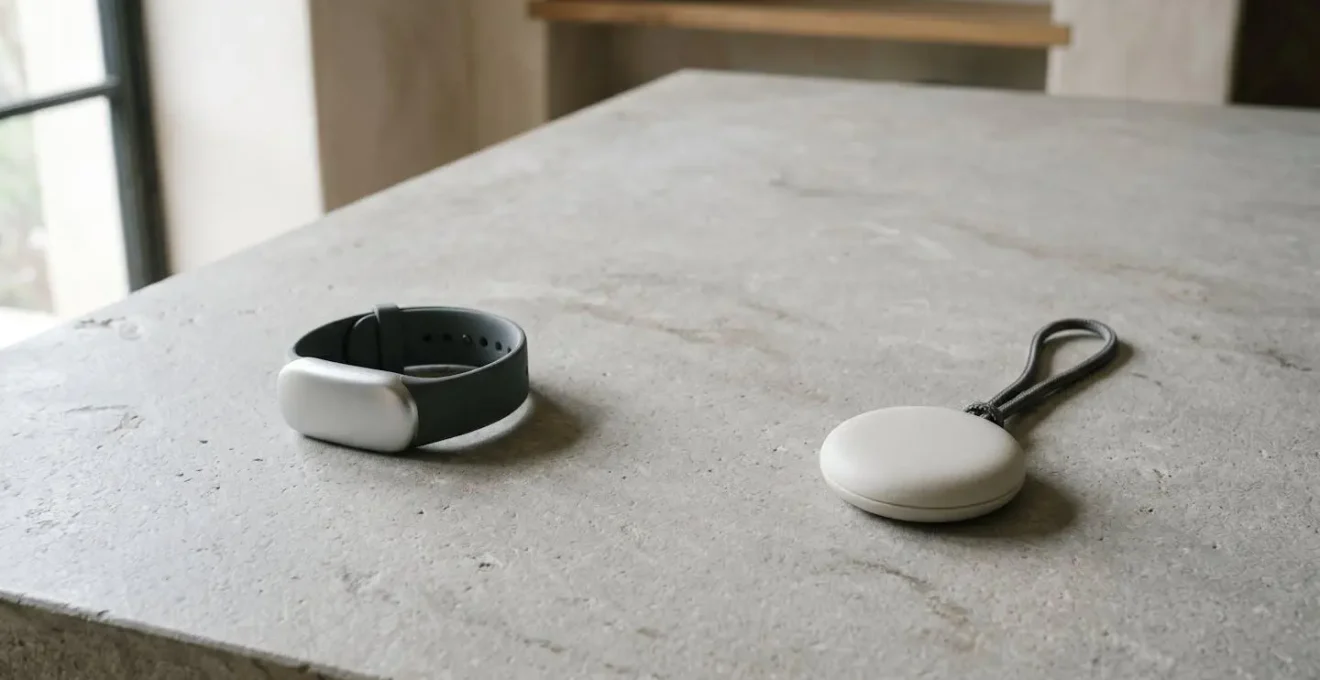
Scientific research supports this principle. Studies analyzing sensor placement have consistently found higher accuracy with central positioning. For instance, specific research demonstrates that fall detection can reach 98.42% accuracy when the sensor is placed on the waist. This is because movements of the torso are far more likely to be representative of the entire body’s stability and state. While a wristband may be more discreet or fashionable, for users prioritising maximum accuracy and reliability, a pendant or waist-worn device is the technically superior choice.
The error of taking the device off because it beeps every time you chop vegetables
The temptation to remove a fall detector due to false alarms is a critical point of failure in any personal safety system. A device left on a nightstand offers zero protection. This issue arises from the challenge of threshold calibration. An algorithm must decide what level of force and speed constitutes a fall. If the threshold is too low, it can be triggered by harmless activities. As research from the Medical Alert Buyers Guide points out, « A false alarm could be triggered by slapping a hand on the table for effect, or by clapping the hands together… or even by chopping vegetables. » These actions can create a short, sharp G-force spike that mimics the algorithmic signature of an impact.
Removing the device is a behavioral reaction to a technical problem, but it’s the wrong solution. The engineering approach to this problem is twofold. First is the continuous improvement of algorithms. Advanced systems don’t just look at a single impact; they use contextual analysis. The algorithm might check for an orientation change (via a gyroscope) and a lack of subsequent movement before confirming an alarm. Chopping vegetables involves repeated sharp movements, but the body remains upright, a pattern a smart algorithm can learn to ignore.
Second, some systems offer adjustable sensitivity settings. This allows the threshold calibration to be fine-tuned to a user’s specific lifestyle. A very active individual might opt for a lower sensitivity setting to reduce false positives, accepting a minuscule trade-off in detecting the very softest falls. The key is to see false alarms not as a sign the device is « broken, » but as an indication that its sensitivity may need adjustment or that its algorithm is less sophisticated. Discarding the protection entirely because of occasional over-sensitivity is a dangerous error that leaves the user completely vulnerable.
How to remember to charge a daily device when you have memory issues?
For a device designed to protect individuals who may have memory challenges, ensuring it remains charged is a significant design and usability problem. Relying solely on memory to perform a novel daily task is a flawed strategy. The engineering solution is to design a system around the user, integrating the charging process seamlessly into existing, deeply ingrained daily routines. This approach, known as « habit stacking, » involves linking the new habit (charging the device) with an old, automatic one (like taking medication or brushing teeth).
While many modern devices offer extended battery life, with some commercial GPS fall detection systems offering up to four days on a single charge, a daily or regular charging routine is still the most reliable method. The goal is to make charging as automatic and thought-free as possible. Instead of trying to remember to charge the device, the environment itself should provide the reminder. Placing the charging cradle in a high-visibility, high-traffic location associated with another daily ritual is the most effective strategy.
Creating a robust charging system is essential for the device to fulfill its purpose. A dead battery renders the most advanced technology useless. By treating charging as a system-design problem rather than a memory test, users and caregivers can ensure the device is always ready to provide protection.
Action Plan: Creating a Failsafe Charging Routine
- Place the charger directly beside the daily medication box to create a powerful visual charging reminder.
- Position the charging dock next to the toothbrush holder to link charging with a consistent morning or evening routine.
- Set a recurring daily alarm on a smartphone or clock specifically labelled as a « device charging reminder. »
- Arrange for a family member or caregiver to include a quick charging check-in as part of a regular daily phone call.
- Investigate devices that offer low-battery SMS alerts that can be sent directly to a caregiver’s phone as a final backup.
The error of using a retractable lead that causes entanglement falls
While this article focuses on the high-tech solutions for fall detection, an engineer’s perspective on safety is holistic. A system is only as strong as its weakest link, and often, the greatest risks are not technological but environmental. The use of a retractable pet lead by a senior is a prime example of an external factor that dramatically increases fall risk, completely bypassing the protection offered by a wearable device. In fact, over 14 million, or 1 in 4 older adults, report falling each year, and many of these falls are due to preventable environmental hazards.
The engineering flaws of a retractable lead in this context are numerous. The thin cord is a significant trip hazard, not only for the user but for others nearby. It can easily become tangled around legs, furniture, or other obstacles, creating a sudden, high-force pull that can easily destabilize an older adult. Furthermore, the locking mechanism can be unreliable or difficult to operate quickly, allowing a pet to suddenly run to the full length of the cord, yanking the user off-balance.
A fall detector will, in most cases, successfully signal an alert after such a fall occurs. However, this is a reactive measure to a preventable incident. The core principle of a robust safety system is to prioritize proactive prevention over reactive protection. In this scenario, the superior engineering solution is to eliminate the hazard. A simple, fixed-length, high-visibility leash provides greater control, reduces the risk of entanglement, and is a far safer choice. It’s a reminder that technology is a safety net, not a replacement for common-sense risk assessment of the user’s environment.
The mistake of treating normal aging processes as diseases requiring aggressive intervention
There is a crucial philosophical and practical distinction to be made between medicalizing the natural process of aging and implementing discreet safety measures to mitigate specific, high-consequence risks. A fall is not a disease, but an event—an event with potentially catastrophic consequences for an older adult’s health and independence. The economic impact alone is staggering; a report from the National Council on Aging highlights how non-fatal older adult falls totaled over $80 billion in U.S. health care costs in 2020. Preventing these events and their costs is a primary goal of proactive aging.
Fall detection technology, when viewed through this lens, is not an « aggressive intervention. » It is not a treatment, a medication, or a therapy. It is a passive safety system, akin to a seatbelt or a smoke detector. It operates silently in the background, demanding nothing from the user until an emergency occurs. As the Fall Prevention Foundation aptly puts it, « Fall detection is a discreet safety net that enables seniors to age in place safely, delaying or preventing the far more aggressive intervention of moving to a care facility. »
Treating a slight decline in balance as a « disease » might lead to over-medication or unnecessary restrictions on activity. In contrast, acknowledging that a person’s fall risk is elevated and implementing a fall detector is an enabling strategy. It provides the confidence for the individual to continue living an active, independent life, knowing that if an accident does happen, help will be summoned quickly. It is a tool that supports autonomy rather than diminishing it, framing safety as a pragmatic part of aging well, not as a medical problem to be solved.
Key takeaways
- True fall detection accuracy hinges on multi-sensor fusion (accelerometers, gyroscopes) to analyze the context of movement, not just a single impact.
- Device placement is a critical engineering factor; sensors on the torso or waist provide a more reliable signal of whole-body movement than those on the wrist.
- Technology is the reactive safety net; proactive fall prevention through professional assessments and environmental risk management is an equally vital part of a complete safety system.
How to access a Comprehensive Geriatric Assessment (CGA) in the UK?
While a fall detection device provides a crucial reactive safety net, a truly robust safety strategy must also be proactive. In the UK, the gold standard for proactive fall prevention and holistic health management in older adults is the Comprehensive Geriatric Assessment (CGA). This is not a single test, but a multi-disciplinary process that evaluates an older person’s physical, psychological, social, and functional capabilities to create a coordinated plan for treatment and support.
Accessing a CGA typically begins with the individual’s General Practitioner (GP). If a senior, a family member, or a caregiver has concerns about increasing frailty, recurrent falls, mobility issues, or a general decline in health, they should schedule an appointment with their GP to discuss these issues. The GP can then make a referral to a local geriatric medicine service, which may be located at a hospital or in a community health setting. These services are staffed by geriatricians, specialist nurses, physiotherapists, and occupational therapists who work together to conduct the CGA.
This assessment forms the first pillar of a « Two-Pillar Strategy » for senior safety. The CGA is Pillar 1: Proactive Prevention. It identifies and addresses the root causes of fall risk, such as medication side effects, vision problems, muscle weakness, or hazards in the home. The fall detection device is Pillar 2: Reactive Protection. It provides the safety net for when a fall occurs despite preventative measures. Data from the fall detector (e.g., time and location of alerts) can even provide valuable feedback to the CGA team, helping to refine the ongoing care plan. This creates a closed-loop system where technology and healthcare work in synergy.
To build a truly comprehensive safety net that inspires confidence, the next logical step is to discuss a formal risk assessment like the CGA with your GP or a trusted healthcare provider.