

Organising personal care is less about completing a checklist of tasks and more about creating a system that protects a person’s dignity and independence.
- Understand the real rules for defining a « care need » to unlock support, moving beyond common myths.
- Focus on achieving positive outcomes—like comfort, safety, and choice—rather than just « getting the job done ».
- Master the UK’s financial support systems, like Attendance Allowance and Disabled Facilities Grants, by articulating needs effectively.
Recommendation: Begin by shifting your mindset. Instead of asking « What tasks need doing? », ask « What outcome do we want to achieve for my loved one’s well-being today? ».
The moment you realise a parent or loved one needs help with the most private aspects of their life—washing, dressing, using the toilet—is a profound and often difficult turning point for any family. The path forward can feel unclear, fraught with emotional complexity and practical questions. You are not just managing a schedule; you are navigating a new relationship dynamic, one where independence and dignity are paramount but assistance has become a necessity.
Common advice often feels inadequate. You’re told to « be patient, » « communicate, » or « get professional help, » but these well-meaning platitudes don’t explain how to have that conversation with a proud parent, how to introduce a stranger into their home for intimate care, or how to navigate the UK’s complex web of social care and financial support. It’s easy to become focused on a task-based approach: a 15-minute visit to get someone washed and dressed before rushing out the door. This method may tick a box, but it rarely supports a person’s quality of life.
This guide offers a different perspective. As a social worker, I’ve seen that the most successful home care isn’t about simply performing tasks; it’s about designing a dignity system. This system is built on three pillars: understanding the official rules that define care, respecting the psychology of receiving help, and mastering the mechanics of the daily routine. The real key is to shift from task-based thinking to an outcome-based approach. It’s not just about putting on socks; it’s about enabling a person to feel safe, comfortable, and ready for their day with their self-esteem intact.
This article will walk you through the practical, legal, and emotional components of building that system. We will explore how to interpret care regulations, make informed decisions about home adaptations, and structure daily routines to preserve energy and promote independence. By the end, you will have a clearer framework for providing care that is not only effective but also deeply respectful.
Summary: A Practical Guide to Organising Dignified Personal Care at Home
- Why do you legally need two carers for hoisting transfers?
- How to help a parent accept intimate care from a stranger?
- Walk-in shower vs bath lift: which is better for heavy dependency?
- The error of leaving a seated senior in the same position for 4 hours
- How to sequence a wash and dress routine to reduce fatigue?
- Why does needing help to put on socks count as a care need?
- Why does ‘task-based’ care fail to improve quality of life compared to ‘outcome-based’ care?
- How does the inability to perform ADLs trigger Attendance Allowance eligibility?
Why do you legally need two carers for hoisting transfers?
One of the most persistent myths in home care is that moving a person with a hoist always legally requires two carers. This belief often causes significant stress for families facing high care costs. The reality, however, is more nuanced and centres on individualised assessment rather than a blanket rule. While it’s true that in some high-risk situations two carers are necessary, this is not a universal legal mandate. According to HSE guidelines, at least 2 carers may be needed: one to operate the hoist and another to support the individual, but this is determined by risk.
The « two-carer rule » stems from a widespread misinterpretation of historical regulations. Research from the University of Salford highlighted that the Domiciliary Care Regulations 2003 stated two people should be involved ‘when the need is identified from the manual handling risk assessment,’ not as a default for every transfer. This is a critical distinction. Many modern hoists, particularly ceiling track systems, are specifically designed to be operated safely by a single, properly trained carer.
The deciding factor should always be a person-specific risk assessment conducted by a competent professional, such as an Occupational Therapist (OT) or a qualified moving and handling advisor. This assessment will consider the individual’s weight, medical condition, level of cooperation, the type of hoist being used, and the physical environment. A single carer may be deemed perfectly safe for a straightforward transfer, whereas a more complex situation might necessitate a second person. The goal is to ensure safety and dignity, not to adhere to a misunderstood and often costly rule.
How to help a parent accept intimate care from a stranger?
Introducing a professional carer for intimate tasks like washing and dressing can be one of the most sensitive challenges a family faces. For a parent, this can feel like a profound loss of privacy, control, and dignity. Resistance, anxiety, or even anger are normal reactions. The key to navigating this transition is to focus on building trust and empowering your parent, rather than imposing a solution. It’s a process, not a single event.
The approach must be gradual and respectful, giving your parent a sense of control at every stage. Before a carer even begins, talk openly about their preferences. Would they feel more comfortable with a male or female carer? What time of day do they prefer for their routine? Involving them in the choice of care agency and even interviewing potential carers can make a significant difference. The goal is to frame the carer as an ally who is there to help them maintain their independence and safety, not someone who is taking over.

Once care begins, a structured and respectful approach is vital for building a trusting relationship. This framework helps establish boundaries and reinforces dignity:
- Always Ensure Privacy: Use screens, close doors, and use towels or blankets to cover the body. This simple act communicates respect for their personal space.
- Explain Every Step: The carer should narrate what they are about to do and ask for permission before proceeding. A calm, respectful tone helps the person feel involved and not just a passive recipient of care.
- Encourage Self-Participation: Support the individual to do as much as they can for themselves, even if it’s just washing their own face. This reinforces their autonomy and self-esteem.
- Acknowledge Feelings: Be patient and understanding. If your parent expresses discomfort, the carer should pause and listen, validating their feelings rather than dismissing them.
Walk-in shower vs bath lift: which is better for heavy dependency?
Choosing the right bathroom adaptation is critical for safety and long-term independence, especially as a person’s mobility needs increase. The decision between a walk-in shower and a bath lift isn’t just about preference; it’s about matching the solution to the level of dependency. For individuals with heavy dependency or who are wheelchair users, a level-access walk-in shower is almost always the superior and more future-proof option. It eliminates the need to step over any threshold, allowing for easier transfers from a wheelchair or with a mobile hoist.
A bath lift, while a good solution for those with light to moderate dependency who can still safely transfer, has significant limitations for more complex needs. It still requires the person to lift their legs over the side of the tub, a movement that can be difficult or impossible for someone with severe arthritis, muscle weakness, or paralysis. For individuals with minimal ability to assist in transfers, a ceiling track hoist system that runs directly into a walk-in shower area provides the safest and most dignified solution. Funding for these major adaptations can often be accessed through a Disabled Facilities Grant (DFG), which, according to the latest government guidance, is a means-tested grant available through your local council following an OT assessment.
The following table compares the main options, highlighting how each solution fits different levels of need and the typical costs and impact involved in the UK.
| Adaptation Option | Best For | DFG Eligibility | Typical UK Cost Range | Installation Timeline | Property Impact |
|---|---|---|---|---|---|
| Walk-in Shower (Level Access) | Moderate to heavy dependency; wheelchair users | Yes, if OT-assessed as necessary | £3,000-£8,000 | 1-2 weeks | Moderate – removes bath |
| Bath Lift | Light to moderate dependency; some mobility retained | Yes, if assessed as appropriate | £300-£2,000 (equipment only) | Immediate (equipment) or 1 week (installation) | Minimal – retains existing bath |
| Ceiling Track Hoist System | Heavy dependency; minimal transfer ability | Yes, often prioritized for complex needs | £8,000-£15,000+ | 3-6 weeks | Significant – ceiling mounted, multi-room possible |
The error of leaving a seated senior in the same position for 4 hours
One of the most dangerous and overlooked risks in home care is prolonged immobility. Allowing a senior with limited mobility to remain seated in the same position for four hours or more is a significant error that can lead to a cascade of serious health problems, most notably pressure ulcers (also known as bedsores). These are not just minor sores; they are painful, debilitating injuries to the skin and underlying tissue caused by sustained pressure that cuts off blood supply. The scale of the problem is vast; pressure ulcers cost the NHS more than £3.8 million every day and affect hundreds of thousands of people annually.
For frail individuals, the risk is exceptionally high. Pressure can build up on bony areas like the base of the spine, hips, and heels in as little as 30 minutes. Leaving someone for four hours without a change in position creates a high-risk environment for tissue damage that can be difficult to heal and lead to severe infections. Preventing pressure ulcers is far easier than treating them and is a fundamental responsibility of good care.
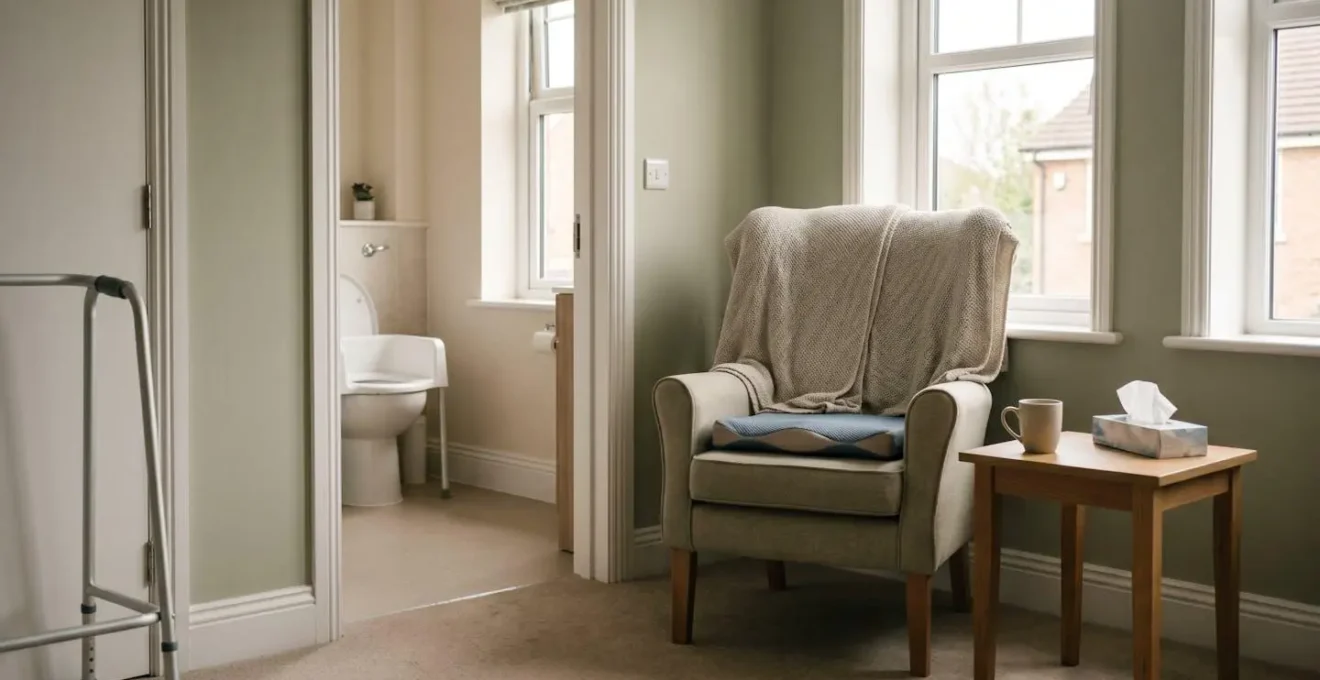
A proactive approach using the NHS’s « SSKIN » framework is essential. This involves regular skin inspection, ensuring good nutrition and hydration, and crucially, keeping the person moving. For at-risk individuals, a structured repositioning schedule is non-negotiable. This doesn’t mean constant disruption, but planned, regular small adjustments.
- Repositioning Frequency: At-risk individuals should be encouraged to change position at least every 2 hours if in a chair, and every 4-6 hours if in bed. Even small shifts in weight can make a big difference.
- Pressure-Relieving Equipment: An OT can assess for and provide specialised pressure-relieving cushions for chairs and mattresses for beds. These range from static foam for lower-risk individuals to dynamic alternating-pressure systems for those at high risk.
- Regular Checks: Carers should be trained to check the skin for early signs of redness or discoloration, particularly over bony prominences.
- Encourage Movement: Even if the person cannot stand, encouraging small movements like lifting their feet or shifting their weight side-to-side helps to restore blood flow.
How to sequence a wash and dress routine to reduce fatigue?
For someone with limited energy due to age or illness, the simple act of washing and dressing can feel like running a marathon. A poorly planned routine can leave them exhausted before the day has even begun, impacting their mood and ability to engage in other activities. The key to managing this is not to rush, but to be strategic. By applying principles of energy conservation, a technique used by occupational therapists, you can transform a draining task into a manageable routine.
The core idea is to break the process down and eliminate any wasted effort. Think of a person’s energy as a finite daily budget; every unnecessary movement or moment of strain is a withdrawal. The goal is to spend that energy wisely on what matters most. This requires a shift from simply ‘doing’ the task to ‘planning’ the task. A well-sequenced routine conserves energy, reduces the risk of falls, and gives the person a greater sense of control and accomplishment.
The « 4 Ps of Energy Conservation » provide a simple yet powerful framework for structuring any personal care routine. By deliberately incorporating these four elements, you can significantly reduce the physical and mental toll of washing and dressing, making the start of the day a positive experience rather than a source of dread.
Your Action Plan: An Energy-Saving Wash and Dress Routine
- Planning: Before starting, lay out all necessary items in the exact order of use. This includes clothes (in the order they will be put on), towels, soap, and any creams. This eliminates searching and unnecessary movement mid-routine.
- Positioning: Maximise seated activities to conserve energy. For example, the person can sit on the edge of the bed to dry and dress their lower body before transferring to the bathroom. Use a shower chair or stool for washing.
- Pacing: Break the routine into smaller, manageable segments. Incorporate short rest periods between tasks, such as resting for a few minutes after showering before starting to dress. This prevents the build-up of exhaustion.
- Prioritising: On days when energy is particularly low, focus on the most essential tasks first. Can some parts of the routine be simplified? For example, using a long-handled sponge can reduce the effort of reaching.
Why does needing help to put on socks count as a care need?
It’s a common misconception that to qualify for disability benefits like Attendance Allowance, a person must have a very severe or complex medical condition. Families often overlook significant daily struggles, thinking, « It’s just a bit of help with socks, that doesn’t count. » This is a fundamental misunderstanding of how care needs are assessed in the UK. The Department for Work and Pensions (DWP) doesn’t just look at the task itself; it assesses the *impact* of that task on the individual using a specific set of principles known as the reliability criteria.
These criteria shift the focus from « can you do it? » to a more holistic evaluation of the effort and risk involved. As the official guidelines state, the real question is whether you can perform the task safely, to an acceptable standard, as often as needed, and in a reasonable amount of time. This is a critical distinction that turns a simple daily struggle into a formally recognised care need. As articulated in the Attendance Allowance Assessment Guidelines, this framework is key.
The assessment isn’t just ‘can you do it?’, but can you do it safely, to an acceptable standard, repeatedly, and in a reasonable time.
– DWP Reliability Criteria, Attendance Allowance Assessment Guidelines
Applying this logic, needing help with socks is no longer a trivial issue. If the act of bending down causes severe pain, creates a high risk of falling (unsafe), takes more than twice as long as an able-bodied person (unreasonable time), or cannot be done every day (not repeatable), then it absolutely qualifies as a care need. The challenge for families is to learn how to articulate these struggles in the language the DWP understands.
Example: Articulating the « Socks » Care Need
Instead of writing ‘I need help with socks,’ a more effective description for a benefit application would be: ‘Due to spinal stenosis and severe arthritis in my hips, I cannot bend to reach my feet without experiencing intense pain and a high risk of losing my balance and falling. My daughter must help me put on my socks and shoes every morning. If I were to attempt this by myself, it would be unsafe, cause significant pain, and take me over 10 minutes, which is not sustainable on a daily basis.’ This detailed explanation directly addresses all four DWP reliability criteria: safety, standard, repeatability, and time.
Key Takeaways
- A care need is defined not just by the task, but by whether it can be done safely, to an acceptable standard, repeatedly, and in a reasonable time.
- An « outcome-focused » approach to care, prioritising a person’s well-being and goals, is recognised by the Care Quality Commission as a marker of outstanding care.
- Personalised risk assessments are crucial for determining safe care practices, such as the number of carers for hoisting, rather than relying on outdated blanket rules.
Why does ‘task-based’ care fail to improve quality of life compared to ‘outcome-based’ care?
In social care, there are two fundamentally different ways of approaching a person’s needs: task-based care and outcome-based care. Task-based care is driven by a checklist. A carer arrives with a list—wash, dress, make breakfast—and leaves once the tasks are complete. This is the model behind the notorious « 15-minute care visit. » While it may seem efficient, it often fails to address the human element. The focus is on the ‘what’, not the ‘how’ or the ‘why’. The person receiving care can feel like an object on a production line, leading to feelings of disempowerment and a reduced quality of life.
In contrast, outcome-based care starts with a different question: « What does this person want to achieve today, and how can we help them get there? » The ‘outcome’ might be feeling clean and comfortable, being able to sit in the garden for an hour, or having the energy to speak to a grandchild on the phone. The tasks—washing, dressing—become the means to that end, not the end itself. This approach is person-centred, flexible, and focuses on promoting well-being and independence. It gives the individual a sense of purpose and control over their own life.
The difference is profound. A task-based carer might rush a person through a shower to stay on schedule. An outcome-based carer might suggest a strip wash at the sink if the person is feeling too tired for a full shower, preserving their energy for something they value more later in the day. This collaborative and respectful approach is not just a ‘nice to have’; it is a core principle of high-quality care recognised by England’s care regulator, the Care Quality Commission (CQC).
Person-centred, outcome-focused care is a key indicator that the Care Quality Commission uses to award Outstanding ratings.
– CQC Fundamental Standards, Care Quality Commission Inspection Framework
How does the inability to perform ADLs trigger Attendance Allowance eligibility?
Attendance Allowance is a crucial, non-means-tested benefit from the DWP for people over State Pension age who have a disability or illness that requires help or supervision. The entire eligibility framework is built around a person’s difficulty with Activities of Daily Living (ADLs). These are the fundamental tasks of self-care, such as washing, dressing, eating, and using the toilet. When an individual needs help with these activities, it directly triggers potential eligibility for the allowance.
The benefit is paid at two different weekly rates, depending on the level of need. The lower rate applies if you need frequent help or constant supervision during the day, or supervision at night. The higher rate applies if you need help or supervision throughout both the day and night. For example, the projected weekly rates for 2026-2027 were set at £76.70 for the lower rate and £114.60 for the higher rate. The key is demonstrating that the need exists, not whether you are actually receiving the help yet. It is a benefit designed to help you afford the support you require.
To qualify, you must be able to describe how your condition affects your ability to perform ADLs. This is where understanding the DWP’s definitions of ‘attention’ and ‘supervision’ becomes vital. ‘Attention’ refers to active, physical help, such as a carer helping you to wash your back, cut up your food, or get dressed. ‘Supervision’ refers to needing someone on hand to keep you safe, for example, to prevent a fall in the shower or to prompt you to take medication if you have cognitive difficulties. The inability to perform ADLs safely, repeatedly, to an acceptable standard, or in a reasonable time, creates the need for this attention or supervision, which in turn unlocks the benefit.
To begin implementing these principles, the next logical step is to document your loved one’s specific needs using the ‘reliability criteria’ framework. This will provide a solid foundation for conversations with healthcare professionals and for any benefit applications you may make.
Frequently Asked Questions about Attendance Allowance and ADL eligibility
What does ‘attention’ mean in the context of Attendance Allowance?
Attention means active, physical help with an Activity of Daily Living (ADL), such as washing your back, helping you dress, or assisting with eating.
What does ‘supervision’ mean for Attendance Allowance eligibility?
Supervision means needing someone nearby to prevent substantial danger, such as preventing a fall in the shower due to dizziness or monitoring your condition to keep you safe.
Do I need to already be receiving care to qualify for Attendance Allowance?
No. You qualify based on the help you need, not the help you currently receive. You don’t have to have a carer or someone looking after you to be eligible.
How can I increase my chances of a successful Attendance Allowance claim?
Keep a detailed care diary for 1-2 weeks before filling in the form, noting every instance of help needed with an ADL, why it was needed, and how long it took. Get free one-to-one help from Citizens Advice or Age UK to complete the AA1 form effectively.