

Finding meaningful social activities in retirement isn’t about accepting the first ‘senior’ club you find.
- It’s about rejecting stereotypes and finding roles that value your life experience, whether through peer-led learning (U3A), skill-based volunteering, or intergenerational projects.
- True connection comes from shared purpose, not just shared time, and the UK has specific pathways like social prescribing to help you find it.
Recommendation: Start by auditing your own skills and passions, then use targeted UK resources like Social Prescribing Link Workers and specialist volunteering platforms to find your perfect fit.
The transition into retirement often comes with a well-meaning but frustrating chorus of suggestions: bridge clubs, bingo halls, and afternoon singalongs. For many, these images feel less like a golden age and more like a patronising cliché. You’ve spent decades honing skills, navigating complex challenges, and building a wealth of experience. The idea of suddenly switching to purely passive, childish pastimes can feel like a step backward, leading to a sense of disconnect and isolation rather than the vibrant social life you envisioned.
This feeling is the search for a ‘Goldilocks’ activity: something that’s not so strenuous it’s exhausting, but not so simple it’s demeaning. It’s about finding a role that is intellectually stimulating, socially rewarding, and genuinely meaningful. The challenge isn’t a lack of options, but a lack of guidance on how to navigate them. Many guides talk about « staying active » but fail to address the core human need for purpose and respect that continues long after your professional life ends.
But what if the key wasn’t just about finding something to *do*, but about intentionally designing a ‘portfolio of purpose’? This approach shifts the focus from simply filling time to curating a mix of activities that nourish different parts of your identity: the learner, the contributor, the mentor, and the social being. It’s about recognising that your value didn’t retire with your job title.
This guide will explore how to build that portfolio in the UK. We will delve into successful models like the U3A, uncover practical ways to overcome logistical barriers like transport, and identify how to find roles that leverage your unique professional skills, creating a retirement that is not just busy, but deeply fulfilling.
This article provides a structured path to finding activities that truly fit. Below is a summary of the key areas we will explore to help you design a retirement filled with purpose and genuine connection.
Summary: How to find ‘Goldilocks’ activities in the UK: a guide to a purposeful retirement
- Why is the peer-learning model of U3A so successful for retirees?
- How to use community transport schemes to get to the club?
- Charity shop vs mentoring: which volunteering role boosts mental health more?
- The mistake of joining a clique-heavy group that makes you feel excluded
- How to find projects where you work with young people?
- How to find high-impact volunteering roles in the UK that use your professional skills?
- How to find local ‘Men in Sheds’ or social prescribing groups to combat loneliness?
- How to design a fulfilling retirement routine in the UK without spending a fortune?
Why is the peer-learning model of U3A so successful for retirees?
The search for stimulating activity in retirement is often a rejection of top-down, « teacher-knows-best » structures. After a lifetime of experience, being treated as an empty vessel waiting to be filled is deeply unsatisfying. This is precisely why the University of the Third Age (U3A) model has become a powerhouse of positive ageing. Its success is rooted in a simple, revolutionary idea: peer-led learning. Members are both students and teachers, sharing their own knowledge and passions, from quantum physics to garden design, in a respectful, collaborative environment.
This approach dismantles the traditional hierarchy of education. It validates the lifetime of knowledge that each member brings, fostering a sense of competence and mutual respect. The growth of the movement is a testament to its appeal; there are now over 1,000 local U3A groups across the UK, connecting hundreds of thousands of members. While membership isn’t free, the annual fees are typically minimal (£15-£40), covering administrative costs and providing access to a vast array of interest groups.
The U3A’s effectiveness is captured in its PEER model, which stands for Pioneering, Experience-based, Empowering, and Responsive. This framework isn’t just about learning; it’s about co-creation and sustainability.
Case Study: The U3A’s Sustainable Cycle of Learning
The U3A Digital Mentoring Program highlighted the power of its experience-based model. It was developed by older adults for older adults, acknowledging the universal desire to keep learning. A key observation was that many mentees, after gaining new digital skills, would naturally progress to become mentors themselves. This creates a sustainable cycle of peer-led learning that continually refreshes the pool of expertise and reinforces a culture where everyone is a valued contributor, not just a passive recipient. It’s a system built on empowerment, not dependency.
By positioning every member as a potential expert, the U3A directly counters the infantilising stereotypes of retirement. It provides a platform not just for learning, but for continued personal growth and meaningful social contribution, making it a cornerstone of a purposeful retirement portfolio.
How to use community transport schemes to get to the club?
Finding the perfect activity is only half the battle; getting there can be a significant hurdle, especially if driving is no longer an option or public transport routes are inconvenient. Lack of accessible transport is a primary driver of social isolation. However, a network of community transport schemes exists across the UK specifically to bridge this gap. These services are far more than just a taxi; they are a lifeline to independence and social connection, often run by charities and staffed by trained volunteers.
Services like Dial-a-Ride or local voluntary car schemes are designed to be affordable and user-friendly. Many offer a ‘through-the-door’ service, where the driver provides assistance from your front door to the vehicle and into your destination, offering a level of support that standard transport doesn’t. This can be crucial for building the confidence needed to join a new group or attend a regular meeting. The first step is to identify your local provider, which can usually be done via the Community Transport Association website or by contacting your local council or Age UK branch.
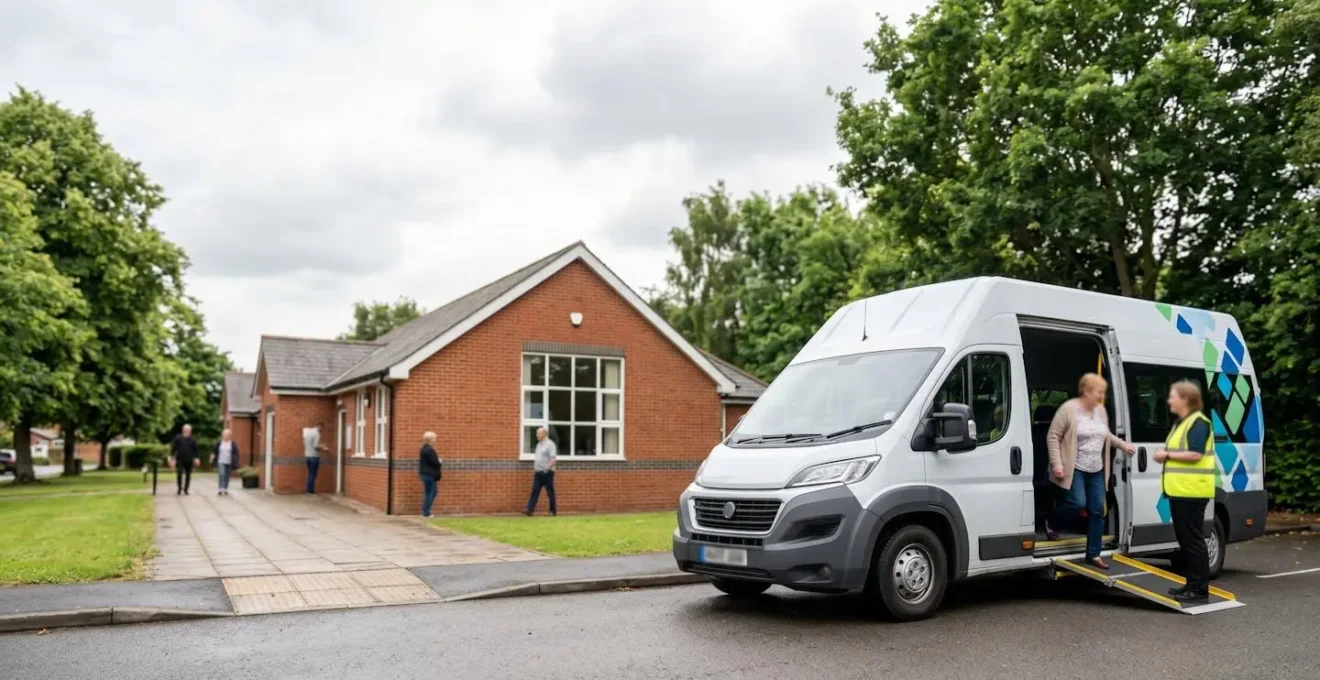
Before committing, it’s vital to vet the service to ensure it meets your specific needs. Understanding their booking procedures, geographical limits, and fee structure is essential for a smooth experience. A good service should be transparent and accommodating, acting as an enabler for your social life, not another source of stress. Asking the right questions upfront can make all the difference in turning transport from a barrier into a tool for empowerment.
Here are some key points to verify when choosing a provider:
- Booking Window: Most services require booking 24-48 hours in advance. Check this aligns with your planning style.
- Geographical Boundaries: Confirm the service covers the full route from your home to your activity location.
- Driver Training: Inquire if drivers have specialised training, such as dementia awareness or first aid, which indicates a higher level of care.
- Fee Structure: Understand the full cost, which often includes a small annual membership fee (£10-£20) plus a charge for each journey.
- Cancellation Policy: Know the terms for rescheduling to avoid unexpected fees.
Charity shop vs mentoring: which volunteering role boosts mental health more?
Volunteering is frequently recommended for retirees, but the generic advice to « help out at a charity shop » overlooks a crucial truth: not all volunteering is created equal. The impact on your mental health and sense of purpose depends heavily on the alignment between the role’s demands and your personal ‘why’. It’s about matching the ‘dose’ and ‘type’ of contribution to your psychological needs. A role that provides routine and social contact serves a different purpose from one that offers a deep sense of legacy.
Research into volunteering distinguishes between different models of engagement, each offering unique benefits. A role in a charity shop, for example, provides routine social contact and a structured environment. This can be profoundly effective at combating loneliness and providing a sense of belonging for someone who thrives on regular, predictable interaction. It’s a steady ‘dose’ of community connection.
In contrast, a mentoring role offers a different kind of reward. It is a ‘direct impact’ activity, where you can witness the tangible results of your contribution. Sharing your wisdom and expertise to help someone else grow delivers a powerful boost to self-esteem and purpose. An influential study suggests that for these benefits to be sustained, a commitment of 100+ hours per year is often required, indicating that the depth of impact is linked to the level of investment.
The key is to honestly assess what you are seeking. Is it daily structure and light social interaction, or the profound satisfaction of creating a lasting impact? The following table breaks down these distinctions to help guide your choice.
| Volunteering Type | Primary Mental Health Benefit | Ideal ‘Why’ | Optimal Dose |
|---|---|---|---|
| Routine Social (Charity Shop) | Combats loneliness through daily structure and regular social contact | Need for routine, social interaction, sense of belonging | Regular weekly commitment (2-4 hours) |
| Direct Impact (Mentoring) | Enhanced self-esteem and purpose through witnessing tangible results | Desire to share wisdom, see direct impact, use expertise | 100+ hours per year for sustained benefits |
| Legacy/Project-Based | Deepest sense of purpose through creating lasting value and strategic contribution | Need to leave a mark, use professional skills, create enduring impact | Project-based (3-6 months intensive) |
Neither role is inherently ‘better’; the most beneficial one is the one that aligns with your core motivation. Choosing consciously, rather than just filling a gap, is what transforms volunteering from a simple pastime into a cornerstone of well-being.
The mistake of joining a clique-heavy group that makes you feel excluded
There is perhaps no greater deterrent to joining a new group than the feeling of walking into a room and hitting a wall of established friendships. The excitement of a new activity can quickly curdle into disappointment and renewed isolation when faced with a clique-heavy environment. These are groups where conversations are dominated by inside jokes, newcomers are ignored, and social circles are physically closed off. It’s a common and deeply dispiriting experience that can make you feel more lonely than when you were at home.
The mistake is not in trying, but in persisting with a group that is fundamentally unwelcoming. Recognising the ‘red flags’ of an exclusionary group early on is a crucial act of self-preservation. A healthy, thriving community group actively works to integrate new members. This might be through a designated ‘welcomer’, by rotating leadership roles, or simply by having a culture where members consciously make space for others. A group’s health can be judged by how it treats its newest and most vulnerable members.

When you visit a group for the first time, think of yourself as an anthropologist. Observe the dynamics before you commit. Do people make eye contact and smile? Do they ask you questions about yourself? Or do conversations halt when you approach, only to resume once you’ve moved away? Research on social inclusivity confirms that these small signals are powerful indicators of a group’s true character. A welcoming group will feel different; there will be an energy of openness and curiosity.
Protecting your emotional well-being means being willing to walk away from a bad fit. It is better to spend a little more time searching for the right community than to invest your energy in a place that will only drain it. Before your first visit, arm yourself with a mental checklist of what to look for.
Your Pre-Commitment Checklist: Spotting Red Flags in a New Group
- Observe Conversation Patterns: Are conversations dominated by inside jokes and references to past events, or do members try to provide context for newcomers?
- Look for a Welcomer: Is there a person, official or not, who makes a point of greeting new people and introducing them to others? Or are you left to fend for yourself?
- Notice Physical Positioning: Do members form closed circles with their backs turned outward, or are circles open and easy to join?
- Monitor the Flow: When you approach a conversation, is an effort made to include you? Or does the group fall silent or turn away? As a study from Cambridge University on social inclusivity within the U3A highlights, these micro-behaviours are key.
- Assess Openness to Your Input: If you offer an idea or a comment, is it acknowledged and considered, or is it ignored in favour of input from established members?
Trust your instincts. If a group makes you feel small or invisible on the first visit, it is unlikely to change. Your time and energy are precious; invest them in a community that values your presence.
How to find projects where you work with young people?
One of the most powerful ways to find purpose and combat age-related stereotypes is through intergenerational projects. The energy, perspective, and technological savvy of younger people, when combined with the wisdom, experience, and patience of older adults, can create a uniquely vibrant and mutually beneficial dynamic. These projects break down societal silos and foster a powerful sense of shared community, reminding us that we have much to learn from each other, regardless of age.
The key to a successful intergenerational project is avoiding tokenism. The most impactful programmes are those where older adults are not just passive recipients of ‘help’ from the young, but are active partners in a process of mutual exchange. This means looking for projects that are co-designed, where activities are developed with input from both age groups to ensure they are meaningful for everyone involved. This shifts the dynamic from one of charity to one of collaboration and shared purpose.
Finding these opportunities requires looking beyond traditional volunteering roles. Organisations like The Cares Family (in London, Manchester, and Liverpool) or local initiatives funded by bodies like The National Lottery Community Fund often pioneer these models. You can also approach local schools, youth clubs, or universities to see if they have or would be interested in starting a mentoring or skills-sharing programme. Frame your offer not just as « wanting to help, » but as a desire for a « mutual exchange of skills and perspectives. »
Case Study: The Ageing Better Co-Design Model
The National Lottery Community Fund’s Ageing Better programme documented a highly successful project in Leicester. It brought older people in care homes together with young volunteers for creative activities. Crucially, the activities were not pre-planned but were built week-by-week based on the interests and ideas of all participants. A report on the programme found that this flexible, person-centred approach, where older adults had valued roles, created the strongest sense of purpose and significantly reduced feelings of isolation for both generations. It proved that meaningful participation is the key ingredient.
This approach requires an open mind and a willingness to step outside of age-segregated comfort zones. But the reward—a renewed sense of relevance, the joy of mentorship, and a genuine connection to the wider community—is one of the most profound available in retirement.
How to find high-impact volunteering roles in the UK that use your professional skills?
After a long and successful career, the idea of volunteering can be appealing, but the thought of stacking shelves or making tea might not feel like the best use of your hard-won expertise. A huge, often untapped, opportunity in retirement is skill-based volunteering: using your professional background in areas like finance, marketing, HR, or strategy to provide high-level support to charities and non-profits. This is not just ‘helping out’; it’s making a strategic contribution that can transform an organisation.
This form of volunteering provides a profound sense of purpose because it directly validates your professional identity and experience. You are not just a pair of hands; you are a strategic asset. The contribution of such volunteers is immense. For instance, a UK Parliament submission noted that across the U3A, with its history of over 40 years of sustained growth, all members are effectively active volunteers contributing their skills to run the organisation, showcasing the scale of this impact.
The challenge is that these roles are rarely found on generic job boards. You need to look on specialist platforms that act as matchmakers between professionals and third-sector organisations. These platforms allow you to search for roles that specifically require your skill set, whether it’s serving as a charity trustee, mentoring a social enterprise leader, or providing pro bono consulting on a critical project. This is about finding a role that is as intellectually challenging and rewarding as your previous career.
To find these high-impact opportunities, you need to know where to look. Here are some of the UK’s leading platforms for skilled volunteering:
- Reach Volunteering: The UK’s leading skill-based volunteering charity, with thousands of roles for professionals in every sector.
- The Cranfield Trust: Specifically provides pro bono management consultancy for charities, leveraging the skills of retired executives and business leaders.
- Governors for Schools: Matches skilled professionals with schools needing strategic leadership on their governing boards—ideal for those with a background in finance, HR, or law.
- Charity Trustee Roles: Search for trustee positions on platforms like Reach Volunteering or directly through the websites of charities you admire. This is a key governance role requiring strategic oversight.
- Pro Bono Economics: Connects volunteer economists and data analysts with charities that need help with research, impact measurement, and analysis.
By targeting these platforms, you can move beyond generic volunteering and find a role that not only gives back to the community but also keeps your professional mind sharp and engaged, forming a vital part of your purpose portfolio.
How to find local ‘Men in Sheds’ or social prescribing groups to combat loneliness?
Sometimes the biggest barrier to connection is not knowing how or what to ask for. The UK’s healthcare system has increasingly recognised that loneliness is a serious health issue, and has developed a formal pathway to help: social prescribing. This is a service where GPs and other healthcare professionals can refer patients to a ‘Social Prescribing Link Worker’, whose job is to connect them with non-medical sources of support in their community.
A Link Worker is a guide, not a clinician. They take the time to have a one-on-one conversation with you about your interests, your passions, and what you feel is missing from your life. They have an in-depth knowledge of local groups, activities, and services, from walking clubs and art classes to more specific initiatives like Men in Sheds. They help you co-create a personalised plan and can even provide support in making that first contact, breaking the cycle of isolation with practical, tailored support.
One of the most successful initiatives often recommended by social prescribers is ‘Men in Sheds’. This movement addresses a key insight into social connection: many people, particularly men, bond more easily ‘shoulder-to-shoulder’ than ‘face-to-face’.
Shoulder-to-Shoulder vs. Face-to-Face Connection
Research highlights that bonding doesn’t always happen through direct, emotional conversation. The ‘shoulder-to-shoulder’ model, exemplified by Men in Sheds, involves connecting while engaged in a shared, practical task like woodworking, repairing bikes, or gardening. This creates a relaxed environment where conversation can happen naturally, without pressure. It is particularly effective for those who find traditional talk-based support groups uncomfortable. It combats isolation through meaningful, shared activity, fostering connection through doing rather than discussing.
Accessing this support system is straightforward. The first step is to talk to your GP or practice nurse and be open about feeling lonely or socially isolated. This is not a sign of weakness; it is a recognised health need. Here is the typical pathway:
- Step 1: Book an appointment with your GP or a nurse at your practice.
- Step 2: Explain that you are experiencing social isolation and request a referral to the Social Prescribing Link Worker.
- Step 3: Attend a consultation with the Link Worker to discuss your interests and needs.
- Step 4: Co-create a non-medical action plan that might include groups like Men in Sheds, a local U3A, or a volunteering opportunity.
- Step 5: Receive support from the Link Worker to make contact with the group and for follow-ups to see how you are getting on.
Key takeaways
- Finding fulfilling retirement activities is about building a ‘Portfolio of Purpose’ that aligns with your skills, not just filling time.
- Leverage UK-specific pathways like Social Prescribing and specialist platforms for skilled volunteering to find high-impact roles.
- The best social models for retirees, like U3A and Men in Sheds, are based on peer respect and shared activity, not passive entertainment.
How to design a fulfilling retirement routine in the UK without spending a fortune?
Designing a fulfilling retirement is not about having an endless budget; it’s about smart, intentional planning. The most satisfying routines are not packed with expensive cruises and classes, but are built on a balanced ‘portfolio of purpose’ that nourishes different aspects of your well-being without breaking the bank. By strategically combining low-cost and no-cost activities, you can create a rich, stimulating, and socially connected life.
The ‘Balanced Portfolio’ approach involves consciously allocating time each week to four key areas: Social Activity (connection), Purpose Activity (contribution), Growth Activity (learning), and Wellbeing Activity (health). This ensures you are not just ‘busy’, but are actively investing in a holistic sense of wellness. The UK is rich with resources that fit perfectly into this model, many of which are free or require only a small fee.
For example, a ‘Growth’ activity could be attending free online lectures from Gresham College or contributing to a citizen science project on Zooniverse from your own home. A ‘Wellbeing’ activity could be joining a local walking group or using a Senior Railcard to visit one of the UK’s many free national museums. The key is to see these not as random pastimes, but as deliberate investments in your mental and physical health. The following table provides a framework for how to structure this weekly portfolio.
| Activity Category | Human Need Served | Low-Cost UK Examples | Recommended Weekly Time |
|---|---|---|---|
| Social Activity | Connection, belonging, combating loneliness | U3A groups, coffee mornings, library clubs | 2-4 hours (1-2 sessions) |
| Purpose Activity | Contribution, meaning, value to others | Volunteering (charity shop, mentoring, trustees) | 3-5 hours (100+ hours/year) |
| Growth Activity | Learning, mental stimulation, competence | Free Gresham College lectures online, Zooniverse citizen science, U3A courses | 2-3 hours |
| Wellbeing Activity | Physical health, stress reduction, vitality | Walking groups, free museum visits with Senior Railcard, park walks | 3-5 hours |
Building this routine is about being resourceful. Your local public library is a hub of free resources, from books and internet access to community events. Community transport schemes can provide affordable access to these activities. By combining these elements, you create a resilient and deeply rewarding retirement lifestyle that is rich in experience, not in expenditure.
Your fulfilling retirement is not a happy accident; it’s a design project. Begin today by exploring one of the specialist platforms or contacting your local GP for a social prescribing referral to build your own portfolio of purpose.