

Choosing a Class 3 scooter is a strategic move to maintain independence, not just a technical purchase; success depends on matching the machine to your lifestyle, not just the legal requirements.
- The real value of a premium Lithium battery lies in its longevity and reliability, drastically reducing long-term costs and charging frustrations.
- While not mandatory, forgoing insurance exposes you to significant personal liability for accidents, turning a mobility asset into a financial risk.
Recommendation: Prioritise your living situation (storage, charging) and typical journey distance (battery choice) before focusing on the scooter’s top speed.
For many seniors in the UK, the decision to stop driving a car can feel like a significant loss of freedom. The ability to visit friends, attend appointments, or simply go to a larger supermarket suddenly becomes a complex logistical challenge. While mobility scooters are often presented as the solution, the choice is far from simple. Many guides focus on basic features, but the real challenge isn’t just picking a model—it’s integrating a new form of transport into your life seamlessly. You don’t need a driving licence, but you do need to understand the profound differences between pavement-only models and their road-going counterparts.
The common advice is to look at speed and range, but this is a superficial view. The true key to unlocking outdoor freedom lies deeper, in factors often overlooked until it’s too late. What if you live in a flat with no garage? How do you manage charging? Is the higher upfront cost of certain technologies a worthwhile investment or an unnecessary expense? The mistake is to view the scooter in isolation. It must be seen as a complete system that includes your home, your travel habits, and your financial security.
This guide moves beyond the basics. We will adopt a strategic approach, focusing on the critical, often-unseen decisions that determine whether your new scooter becomes a true car replacement or a frustratingly limited gadget. We will dissect the technical specifications, the legal nuances, and the practical logistics that together create a successful transition to powered mobility. From understanding why only certain scooters can be on the road to leveraging NHS funding, this is your expert brief on making a choice that genuinely restores your independence.
To navigate these crucial considerations, this article is structured to answer the most pressing questions you’ll face. The following summary outlines the key areas we will explore to ensure you are fully equipped to make the best decision for your freedom and safety.
Summary: Your Path to a Road-Ready Mobility Scooter
- Why can’t you drive a Class 2 scooter on the road legally?
- How to store and charge a scooter if you live in a flat with no garage?
- Lithium vs Lead Acid: is the extra cost worth it for range?
- The mistake of driving without insurance (even though it’s not legally mandatory)
- How to take your scooter on a train using the ‘Passenger Assist’ app?
- The error of staying in a remote village home that leads to ‘transport isolation’
- How to use a Personal Wheelchair Budget to top-up for a better model?
- How to qualify for an NHS powered wheelchair assessment in the UK?
Why can’t you drive a Class 2 scooter on the road legally?
The legal distinction between Class 2 and Class 3 mobility scooters is fundamentally about safety and fitness for purpose on UK roads. A Class 2 scooter cannot be legally used on the road—except to cross it—because it lacks the essential features and performance characteristics required to integrate safely with other traffic. These devices are designed exclusively for pavement use and are therefore electronically limited to a maximum speed of 4mph.
In contrast, Class 3 scooters are specifically designed for road use. The core difference is their capability and equipment. According to official UK Government guidance, Class 3 scooters can reach a maximum speed of 8mph on the road, although they must be switched to a 4mph limit when on pavements. This higher speed capability is what makes them viable for keeping pace with slow-moving town traffic, but it also necessitates a suite of mandatory safety features not found on their Class 2 counterparts.
To be classified as road-legal, a Class 3 scooter must be equipped like a small vehicle. This is not optional; it is a legal requirement for the manufacturer and a crucial safety check for the user. The required equipment includes:
- A full lighting suite, with working front and rear lights for visibility at night and in poor weather.
- Direction indicators to signal your intentions to other road users.
- An audible horn to alert pedestrians and drivers of your presence.
- At least one rear-view mirror to monitor traffic behind you.
- An amber flashing beacon, which is mandatory if you intend to use the scooter on a dual carriageway with a speed limit of 50mph.
Essentially, a Class 2 scooter is a pedestrian aid, while a Class 3 scooter is a vehicle. Attempting to use a Class 2 machine on the road is not only illegal but also extremely dangerous due to its low speed and lack of visibility features, making it virtually invisible and unpredictable to car drivers.
How to store and charge a scooter if you live in a flat with no garage?
For individuals living in flats, apartments, or homes without a garage, the logistics of storing and charging a large Class 3 scooter presents a significant challenge. These are not small, foldable devices; they are substantial mobility assets that require secure, weatherproof protection and a reliable power source. Leaving a valuable machine in a communal hallway is often against fire regulations and lease agreements, while outdoor exposure can lead to theft, vandalism, and rapid deterioration.
The most robust solution is a dedicated, secure outdoor storage unit. These specialist metal sheds are designed specifically for mobility scooters, offering a combination of security and practicality. They are typically made from heavy-gauge, galvanised steel and feature reinforced doors, drill and pick-resistant locks, and options for bolting the unit to a solid concrete base. This provides a high level of protection against both theft and the elements.
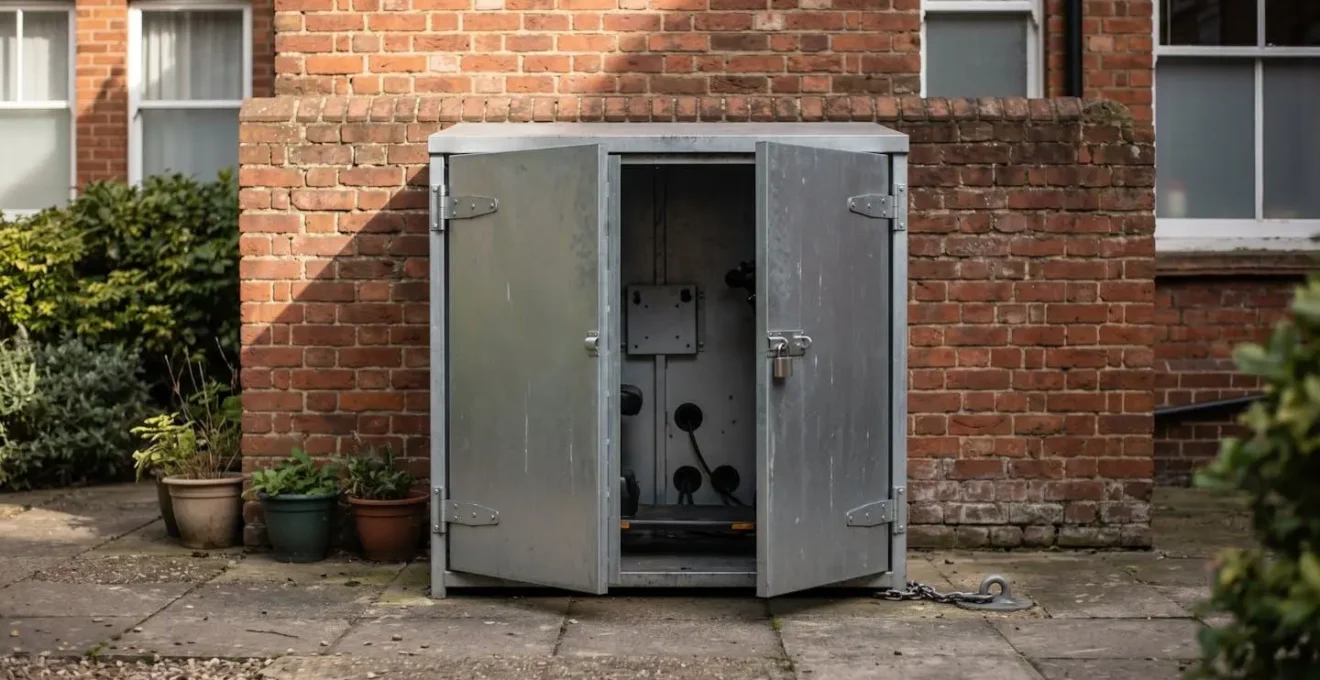
Crucially, these storage units are designed with charging in mind. They incorporate features like pre-drilled holes for routing an armoured power cable from your flat, along with internal mounting plates for fitting electrical sockets. This allows you to create a secure, self-contained charging station right outside your home. Before investing, it’s essential to get permission from the property management company or council, ensuring your chosen location doesn’t obstruct communal pathways or access points.
An alternative for those with ground-floor access might be installing a ramp to bring the scooter indoors. However, the size and weight of a Class 3 scooter can make this impractical for many indoor spaces. Therefore, for most flat-dwellers, a dedicated storage unit is the most effective strategy for protecting their mobility asset and ensuring it is always charged and ready for use.
Lithium vs Lead Acid: is the extra cost worth it for range?
The choice of battery technology is one of the most critical decisions when purchasing a Class 3 scooter, directly impacting range, usability, and long-term cost. While traditional Sealed Lead Acid (SLA) batteries have a lower upfront cost, Lithium-ion (Li-ion) batteries, despite their premium price, offer transformative advantages, particularly for someone relying on the scooter as their primary mode of transport.
The debate isn’t just about maximum range on a single charge; it’s about day-to-day practicality. A Lithium-ion battery is significantly lighter and has a much higher energy density, meaning it stores more power for its weight. This makes the scooter easier to handle and can even improve performance. Furthermore, their charging time and lifespan are dramatically superior, which is a crucial factor for daily users. An analysis from a comparative study of battery types highlights these stark differences.
| Feature | Lithium-ion Battery | Lead-acid Battery |
|---|---|---|
| Weight (12V equivalent) | 7-8kg | ~20kg |
| Charging time to 80% | 2 hours | 8-12 hours |
| Lifespan (charge cycles) | 2,000-5,000 cycles | 300-800 cycles |
| Cold weather performance (-20°C) | Retains ~80% capacity | Retains only ~30% capacity |
| Energy density | 3x more per kg | Standard baseline |
| Upfront cost | Higher (premium investment) | Lower (budget-friendly) |
| Best for | Daily use, flat-dwellers, transportability | Occasional use, fixed storage |
The long-term value proposition of lithium becomes even clearer when examining lifespan. For a daily user, an SLA battery might need replacing in under two years. In contrast, a high-quality lithium battery can last for over a decade. A report from UK mobility battery specialists shows that Lithium batteries can offer 5,000 cycles, compared to just 500 for standard AGM/SLA batteries. This longevity means the higher initial investment is often recouped over the scooter’s life by avoiding multiple costly battery replacements.
So, is the extra cost worth it? For a user transitioning from a car and seeking maximum freedom and reliability, the answer is unequivocally yes. The faster charging, lighter weight, superior cold-weather performance, and vastly longer lifespan make Lithium-ion the strategic choice for a primary mobility asset.
The mistake of driving without insurance (even though it’s not legally mandatory)
One of the most common and potentially costly mistakes a new Class 3 scooter user can make is to forgo insurance. The legal situation in the UK can be misleading; as the government’s own guidance states, it is not a mandatory requirement. This often leads people to believe it is an unnecessary expense. This is a dangerous assumption.
As the UK Government states in its official guidance, the legal position is clear:
You do not need insurance for a mobility scooter or powered wheelchair, although it’s recommended
– UK Government, GOV.UK Official Guidance on Mobility Scooters
While you won’t be prosecuted for not having a policy, you remain personally and financially responsible for any accident you may cause. A moment’s lapse in concentration in a busy town centre could lead to you colliding with a pedestrian, causing serious injury, or veering into the road and causing a car to swerve and crash. The resulting legal claims for injury or property damage could be financially devastating, potentially running into tens of thousands of pounds or more. Specialist insurance acts as a vital liability shield, protecting your personal assets from such claims.
Comprehensive mobility scooter insurance offers far more than just liability protection. Policies are designed to protect your valuable mobility asset against a range of common risks. For a relatively modest annual premium, you gain peace of mind knowing you are covered. In fact, £2 million third party cover is standard in most UK policies, a sum that reflects the potential severity of liability claims. Driving without this protection is a significant gamble.
Action Plan: Key Coverage to Look for in a UK Mobility Scooter Policy
- Public Liability: Verify that the policy includes at least £2 million in coverage to protect you against claims if you injure someone or damage their property.
- Accidental Damage, Theft & Vandalism: Ensure the policy covers the cost of repairs or replacement for your scooter, especially if stored outdoors.
- Breakdown Recovery: Check for a 24/7 get-you-home service. This is critical if the scooter fails far from home, preventing you from being stranded.
- Fire and Flood Damage: Confirm that your scooter is protected against damage from environmental factors, a key consideration for outdoor storage.
- Worldwide Travel Cover: If you plan to take your scooter on holiday, look for a policy that provides coverage for a set period (e.g., 90 days) abroad.
Treating insurance not as an optional extra, but as an essential component of responsible ownership, is the mark of a savvy and safety-conscious user. The small annual cost is insignificant compared to the catastrophic financial risk of a single accident.
How to take your scooter on a train using the ‘Passenger Assist’ app?
For many, true independence means the ability to travel beyond the immediate vicinity of their home. The UK’s rail network can be a powerful tool for this, but the thought of navigating a large Class 3 scooter through a busy station and onto a train can be daunting. The key to a smooth and stress-free journey is the Passenger Assist service, which is now easily accessible via the National Rail app or by phone.
Passenger Assist is a free, nationwide service that allows you to pre-book support for your rail journey. This isn’t just about getting help with luggage; it’s a comprehensive service designed for users with mobility needs. When you book assistance, you inform the train operator of your specific requirements, including the fact that you are travelling with a mobility scooter. This allows them to make all necessary arrangements in advance.
On the day of travel, trained staff will be ready to meet you. Their most crucial role is deploying a boarding ramp, ensuring you can safely and easily get your scooter from the platform onto the train. Staff will guide you to the designated wheelchair space and ensure you are settled before the train departs. The same process is repeated at any changing stations and at your final destination. This removes all the uncertainty and physical strain of the boarding process.
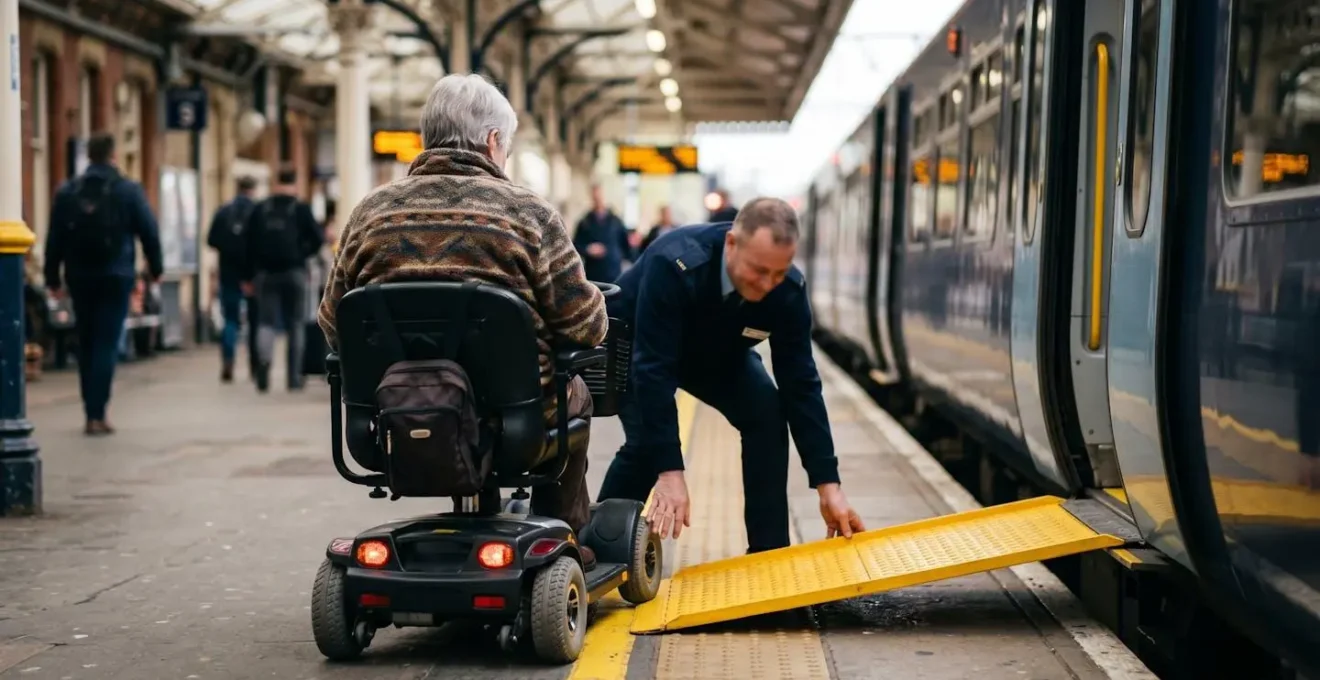
To use the service, you can book through the « Passenger Assist » feature in the National Rail app or by calling them directly. It’s recommended to book at least two hours in advance of your journey to guarantee assistance. When booking, be prepared to provide your journey details and specify that you are travelling with a Class 3 scooter. It’s also wise to check the specific train operator’s policy, as some may have size or weight restrictions, though most modern trains can accommodate standard scooters.
By leveraging this simple but powerful service, the entire UK rail network opens up to you. A trip to see family in another city or a day out at the coast becomes a manageable and enjoyable prospect, transforming your scooter from a local run-around into a gateway for logistical freedom and national travel.
The error of staying in a remote village home that leads to ‘transport isolation’
One of the most challenging situations facing seniors who stop driving is what can be termed ‘transport isolation’. This is particularly acute for those living in rural villages or on the outskirts of towns, where amenities are spread out and public transport is often infrequent, unreliable, or has been cut back entirely. Staying in a beloved family home can inadvertently become a trap, cutting you off from the very community and services you need.
In this context, a Class 3 mobility scooter ceases to be a luxury and becomes a lifeline. It directly counters transport isolation by providing on-demand, personal transport that doesn’t rely on bus timetables or the goodwill of neighbours. The ability to travel independently to the GP, the local shop, or a social club is transformative for mental and physical well-being. This is where the 8mph road-legal speed and extended range of a Class 3 model are not just features, but enablers of a connected life.
Case Study: Overcoming Rural Isolation in the UK
For residents in less urban UK areas, the nearest amenities can be several miles away—a journey too far to walk but too short to justify a taxi. With declining bus services, a trip to the doctor or post office can become a major logistical hurdle. A Class 3 scooter, with a typical range of 25-35 miles, makes these journeys possible. By using quiet country roads (while avoiding dual carriageways with speed limits over 50mph, as per government recommendations), a resident can independently manage their daily errands. This capability transforms a state of dependence and potential isolation into one of self-reliance and active community participation.
The mistake is underestimating the impact of losing a car in a rural setting and choosing a mobility solution that isn’t up to the task. A Class 2 pavement scooter, limited to 4mph, is simply not viable for covering the miles between a village and the nearest town. It is only the road-going capability of a Class 3 machine that can bridge this gap effectively. Investing in the right vehicle is an investment in maintaining your place within your community, preserving social connections, and ensuring continued access to essential services.
How to use a Personal Wheelchair Budget to top-up for a better model?
For those who qualify for an NHS wheelchair, the Personal Wheelchair Budget (PWB) offers a flexible way to get a device that better suits your specific needs and aspirations. Instead of simply being given a standard-issue model, the PWB provides you with a set amount of money, equivalent to what it would cost the NHS to provide a chair that meets your assessed clinical needs. The crucial benefit is that you can then add your own money to this budget to « top-up » for a higher-specification model.
This is particularly relevant when considering a robust Class 3 scooter. The standard NHS provision might be a more basic powered wheelchair or scooter that meets your essential indoor or pavement-based mobility needs. However, it may not have the range, speed, or road-legal features of the Class 3 model you desire for true independence. The PWB acts as a substantial contribution towards that more advanced machine.
The process begins with your NHS assessment. If you are deemed eligible, the clinical team will determine the cost of a suitable standard device; this amount becomes your PWB. For instance, if the standard provision costs £2,000, your budget will be £2,000. If the Class 3 scooter you want costs £3,500, you would be responsible for paying the £1,500 difference. This is known as a « top-up » payment. You would work with an approved NHS supplier to purchase the scooter, combining the NHS budget with your personal funds.
It’s important to note that you become responsible for the insurance, repair, and maintenance costs of the upgraded device, as it goes beyond the standard NHS provision. However, for many, this is a small price to pay for the enhanced freedom, range, and quality of life that a higher-end scooter can provide. The PWB scheme effectively makes premium models more accessible by significantly reducing the out-of-pocket expense.
Key takeaways
- Legal Distinction is Key: Only Class 3 scooters are road-legal in the UK due to their 8mph capability and mandatory safety features like lights and mirrors.
- Plan for Logistics First: Your ability to securely store and charge the scooter, especially if you live in a flat, is as important as the scooter’s features.
- Invest in the Right Battery: For daily use, the higher upfront cost of a Lithium-ion battery is a wise long-term investment due to its superior lifespan and performance.
How to qualify for an NHS powered wheelchair assessment in the UK?
Securing funding or provision through the NHS for a powered wheelchair or mobility scooter starts with a formal eligibility assessment. This process is designed to ensure that resources are directed to those with a significant and long-term clinical need. Qualifying is not about convenience; it’s about meeting specific medical and mobility criteria that demonstrate you are unable to move around your own home effectively without powered assistance.
The primary route to an assessment is through a referral from your GP or another healthcare professional, such as a physiotherapist or hospital consultant. They will refer you to the local NHS Wheelchair Service. This service is typically run by a team of specialists, including occupational therapists and clinical engineers, who will conduct the assessment.
To qualify, you generally need to meet several key criteria. The most fundamental is that your mobility impairment must be long-term (usually defined as longer than six months) and so severe that you are unable to walk at all, or can only walk very short distances, within your home environment. The focus is on indoor mobility first. If you can manage to walk around your home, even with difficulty, you are less likely to qualify for a powered wheelchair for indoor use. Furthermore, you must be able to demonstrate that you can operate the powered device safely and have the cognitive ability to control it without posing a danger to yourself or others.
During the assessment, a clinician will discuss your lifestyle, home environment, and mobility goals. They will assess your physical ability, posture, and seating needs. If they determine you meet the criteria, they will work with you to identify the most suitable piece of equipment to meet your assessed clinical needs. This may not be a Class 3 scooter; it might be an indoor-only powered wheelchair. However, a successful assessment is the gateway to receiving a Personal Wheelchair Budget (PWB), which you can then use to top-up for the Class 3 model you want.
By carefully considering these legal, technical, and financial factors, you can confidently select a Class 3 mobility scooter that not only replaces your car but significantly enhances your freedom and quality of life. The next logical step is to book a consultation with a reputable mobility specialist to discuss your specific needs and test-drive different models.